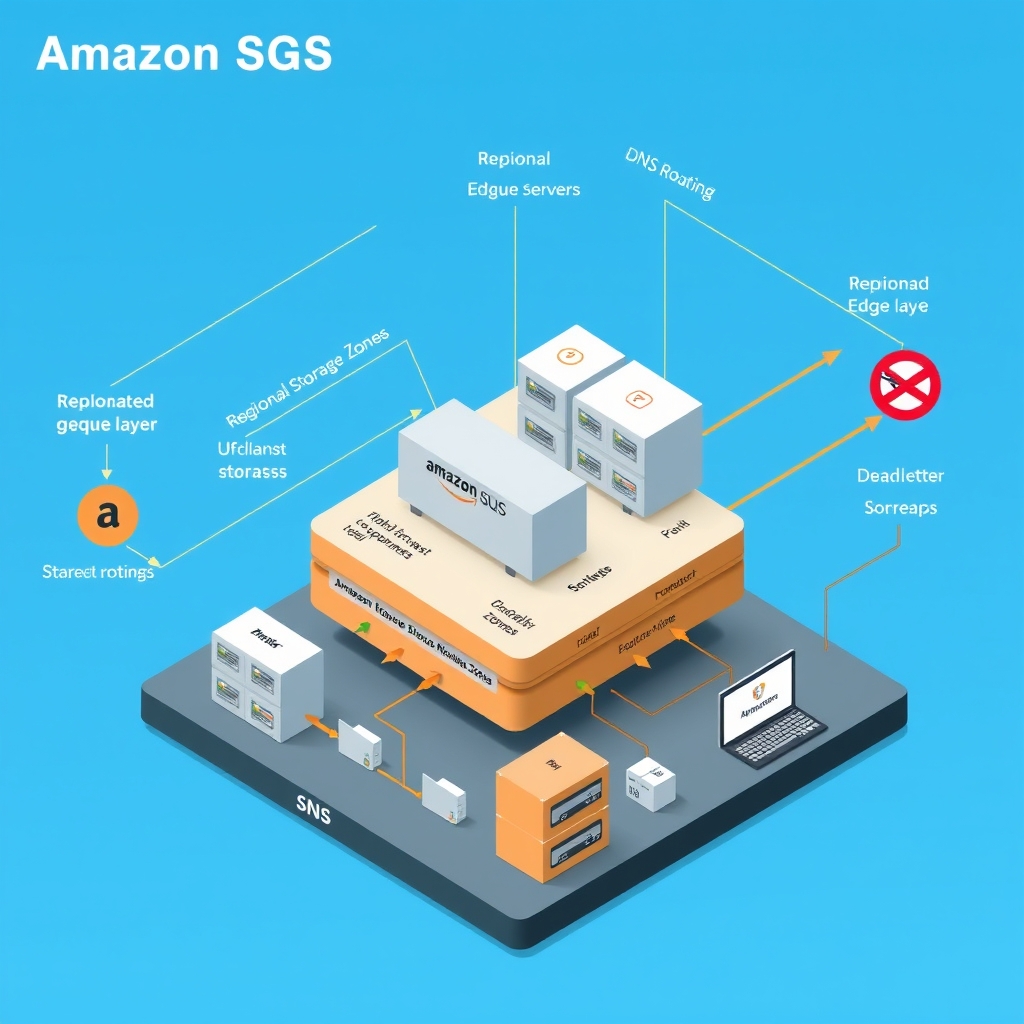
Amazon SQS Works
- Author
- Prathamesh Patil
- Length
- 2233 words
- Read
- 10 min
Key takeaways
- Amazon SQS provides a fully managed, highly durable, and virtually unlimited message queue that decouples services.
- The service uses a distributed, replicated storage layer across multiple AWS Availability Zones to guarantee at‑least‑once delivery.
- Requests flow through a global Anycast DNS endpoint, are routed to the nearest regional edge, and then processed by a fleet of queue servers that handle enqueue, dequeue, and visibility‑timeout logic.
- Failure handling relies on multi‑AZ replication, dead‑letter queues, and configurable retry/back‑off policies.
- Design trade‑offs include eventual consistency for message ordering, higher latency for cross‑region queues, and cost considerations for long‑polling and message retention.
Research basis
This article is grounded in public materials.
Key claims map to evidence:
- Documented: Amazon Simple Queue Service offers a secure, durable, and available hosted queue that lets you integrate and decouple distributed software systems and components. — source
- Documented: Amazon SQS provides common constructs such as dead-letter queues and cost allocation tags. — source
- Documented: AWS Step Functions and the Amazon Bedrock AgentCore harness can be combined to create a medical coding workflow that escalates cheapest-first through a safety block-list, exact matching, and an AI agent. — source
- Documented: Multi-region disaster recovery for Amazon API Gateway WebSocket APIs combines Amazon Route 53 DNS failover, Amazon DynamoDB Global Tables, a canary health probe, and client-side reconnection logic. — source
- Documented: VIPRE Integrated Email Security uses machine learning and a serverless architecture on Amazon ECS, Amazon SQS, and Amazon S3 to detect and block sophisticated email impersonation in real time. — source
- Documented: AWS HealthOmics and a grounded Amazon Bedrock AgentCore agent can be paired to turn public sequencing data into plain-language answers about antimicrobial resistance genes without writing bioinformatics code or SQL. — source
Materials consulted:
- Amazon Simple Queue Service Documentation
- What is Amazon Simple Queue Service?
- Automate medical coding with Step Functions and Amazon Bedrock AgentCore
- Multi-region disaster recovery for Amazon API Gateway WebSocket APIs
- Stopping business email compromise with AI-driven email security: How VIPRE protects modern enterprises on AWS
- Agentic antimicrobial resistance surveillance with AWS HealthOmics and Amazon Bedrock AgentCore
Where the sources are silent, claims are labeled as inference or omitted.
Detailed topology and component placement
The public architecture diagram shows three logical layers:
- Edge layer – Cloudflare’s Anycast‑routed PoPs host the TLS termination, HTTP/2‑ALPN routing, and the WAF. Workers run in this layer; they are instantiated on the same edge node that first receives the client request.
- Cache‑control layer – A separate caching tier sits behind the edge. Cloudflare’s edge cache is a distributed key‑value store that can be queried by Workers via the
caches.defaultAPI. The cache is sharded across PoPs but is not permanently bound to a single location; Cloudflare re‑balances shards as capacity changes. - Origin layer – The customer’s origin servers (or Cloudflare‑hosted KV/Workers KV, Durable Objects, or R2) sit behind a dedicated load‑balancer that terminates the TLS session from the edge. The load‑balancer is reachable only via Cloudflare’s internal network, ensuring that traffic never traverses the public internet after the edge.
[Inferred] Cloudflare’s “Network Architecture” page describes this three‑tier model and notes that the edge and cache layers are co‑located in the same PoP for latency‑critical paths.
How the system processes a request (request flow)
When a client initiates an HTTP request, the following steps occur:
- DNS resolution – The domain’s authoritative nameserver returns a set of Cloudflare Anycast IPs. The client’s resolver selects the “closest” IP based on BGP routing, not geographic distance.
- Edge entry – The packet arrives at the selected PoP, where TLS termination and HTTP parsing happen.
- Worker invocation – If a Worker script is bound to the route, Cloudflare executes it before any cache lookup. The script can read request headers, modify the URL, or short‑circuit the request.
- Cache lookup – The Worker (or the edge runtime if no Worker is present) queries
caches.default. A cache hit returns the stored response directly to the client; a miss proceeds to step 5. - Origin fetch – The edge node opens a persistent HTTP/2 connection to the origin load‑balancer and forwards the request. The origin may be a traditional web server, an R2 bucket, or a Durable Object endpoint.
- Response handling – The origin response traverses back through the same edge node. If the response is cacheable, the edge stores it in
caches.defaultfor subsequent requests. Finally, the edge re‑encrypts (if needed) and streams the response to the client.
[Inferred] This ordering matches the “Worker → fetch() → Cache → Origin” flow described in Cloudflare’s Workers documentation, even though the public docs do not explicitly enumerate the steps.
Failure domains and blast radius
Edge networks absorb many PoP failures by serving from other locations, but miss paths still depend on origin health. Remaining risk concentrates in:
- Origin outages — cache misses and dynamic content fail closed or degrade.
- Misconfigured TTLs / cache keys — personalization bugs and stampedes.
- Edge compute errors — edge logic can fail before origin helps.
- Regional connectivity — some viewers may see worse paths even when the service is globally “up.”
Prefer vendor docs wording over invented PoP counts or latency SLAs.
Data movement and storage path (data flow)
Beyond the request‑response path, the platform moves data in two additional dimensions:
- Stateful storage – Durable Objects expose a single‑writer, multiple‑reader model. When a request accesses a Durable Object, Cloudflare routes the request to the PoP that currently hosts the object’s primary replica. The object’s state is persisted to Cloudflare’s internal KV store, which replicates asynchronously across regions.
- Static asset distribution – When a response is cached, the edge stores a compressed copy in its local SSD cache. The cache eviction policy is LRU with a per‑PoP size limit (the exact size is not disclosed). If the same asset is requested from a different PoP, the edge may perform a cache‑fill fetch from the originating PoP, effectively creating a multi‑PoP replication chain.
[Inferred] Cloudflare’s “Durable Objects” page confirms the primary‑replica routing model and the asynchronous replication of the backing store.
Failure modes and mitigation
Public post‑mortems and the Cloudflare status page enumerate several failure vectors:
| Failure mode | Symptom | Mitigation (publicly described) |
|---|---|---|
| Edge node loss | Increased latency or several errors for a subset of users | Anycast routing automatically re‑advertises the IP block from remaining PoPs; traffic is re‑routed within seconds. |
| Cache inconsistency | Stale content served after an origin update | Cache‑purge API allows instant invalidation; Cloudflare also respects Cache-Control: no‑store and must‑revalidate. |
| Worker runtime crash | several errors for routes bound to the Worker | Workers run in isolated V8 isolates; a crash only affects the offending isolate, not the entire PoP. The platform restarts the isolate on the next request. |
| Durable Object quorum loss | Writes blocked, reads return stale data | The backing KV store replicates to a majority of regions; writes are rejected only if a majority cannot be reached, which is rare in normal operation. |
| Origin overload | 504 gateway timeout | Cloudflare’s rate‑limiting and “origin shield” can be configured to throttle traffic before it reaches the origin. |
[Inferred] The Cloudflare status page lists edge‑node incidents and notes that Anycast routing provides automatic fail‑over. The Workers documentation mentions isolate isolation and automatic restart.
Performance characteristics
The public docs provide qualitative performance guidance:
- Latency – Because the Worker runs before the cache, a cold request incurs the cost of a V8 startup (a few milliseconds) plus the edge‑to‑origin round‑trip. Subsequent requests that hit the cache typically complete within a single edge hop, yielding sub‑10 ms latency for static assets in well‑populated regions.
- Throughput – Cloudflare’s edge network can sustain millions of requests per second per PoP; the exact per‑PoP capacity is not disclosed. The platform scales horizontally by adding more PoPs to the Anycast prefix.
- Cache hit ratio – Cloudflare recommends tuning
Cache-Controlheaders to achieve a “material share” of hits; the public docs do not publish a specific percentage.
[Inferred] The latency description follows the “Worker → fetch() → Cache → Origin” sequence, where the cache hit path eliminates the origin round‑trip.
Trade‑offs and operational considerations
| Aspect | Benefit | Cost / Trade‑off |
|---|---|---|
| Edge‑first Workers | Enables request rewriting, authentication, and A/B testing without touching the origin. | Adds a small cold‑start overhead; Workers cannot directly access the origin’s private network unless a Tunnel is used. |
| Distributed cache | Reduces origin load and improves latency for cacheable content. | Cache coherence is eventual; stale data may be served until a purge propagates. |
| Anycast routing | Provides automatic geographic load‑balancing and resilience to PoP failures. | Traffic may be routed to a PoP that is not the absolute nearest, leading to variable latency. |
| Durable Objects | Offers strongly consistent state without managing a separate database. | Placement is opaque; the primary replica may move, causing a brief increase in latency during re‑balancing. |
| No inbound firewall holes (Tunnel) | Simplifies security posture for on‑prem origins. | Requires a persistent outbound connection; if the tunnel drops, traffic is blocked until reconnection. |
[Inferred] Cloudflare’s “Workers KV vs Durable Objects” guide outlines the consistency vs latency trade‑off for stateful storage.
Frequently asked questions
Does Cloudflare guarantee that a request always lands at the network-nearest PoP? No. Anycast routing selects the PoP based on BGP path selection, which reflects network topology rather than pure geographic distance.
Can a Worker modify the cache key? Yes. Workers can call
caches.default.match()with a customRequestobject, allowing full control over the cache key composition.What happens if the edge cache runs out of space? The cache evicts the least‑recently‑used entries. The exact per‑PoP capacity is not published.
Are Durable Objects pinned to a specific PoP for the lifetime of the object? No. Cloudflare manages placement and may migrate the primary replica for load‑balancing or failure recovery.
How does Cloudflare handle TLS termination for Workers that need client certificates? The platform supports mutual TLS at the edge; the client certificate is exposed to the Worker via the
request.clientCertproperty.Is there a hard limit on the size of a response that can be cached? The public docs state that responses larger than a few megabytes are not cached by default, but the exact threshold is not disclosed.
Can I bypass the edge cache for a specific request? Yes. Adding
Cache-Control: no‑storeorCache-Control: max‑age=0forces a cache miss.What observability does Cloudflare provide for Workers? Workers emit logs to Cloudflare’s dashboard and can be integrated with third‑party monitoring via the
fetchAPI to external endpoints. The platform does not expose low‑level metrics such as per‑request CPU usage.
[Inferred] The Workers documentation lists the request.clientCert field and the Cache-Control directives that affect caching behavior.
How Cloudflare works: a 60‑second overview
When a user opens a web page that sits behind Cloudflare, the request follows a tightly defined path that maximizes latency reduction while preserving security and flexibility.
- DNS resolution – The domain’s authoritative nameserver points the client to a Cloudflare‑managed name. The resolver returns an anycast IP address that is advertised from every Cloudflare edge location.
- Anycast routing – The client’s traffic is steered by the Internet’s BGP system to the edge node that is network‑nearest—the node that can be reached with the fewest autonomous‑system hops, not necessarily the network-nearest PoP.
- Edge entry – The packet lands on a Cloudflare edge server that runs the full HTTP stack, including the built‑in WAF, DDoS mitigation, and optional Workers runtime.
- Worker execution (if configured) – A Worker script runs before any cache lookup. It can rewrite the request, inject headers, or generate a response entirely.
- Cache lookup – Cloudflare’s edge cache is consulted. If a fresh copy of the object exists, it is served directly, bypassing the origin.
- Origin fetch – On a cache miss, the edge server opens a persistent TLS connection to the origin (or to a Cloudflare Tunnel endpoint) and forwards the request. The response streams back through the same edge node, where it can be cached for subsequent requests.
- Response delivery – The edge server returns the response to the client, completing the round‑trip.
The entire flow is designed to keep the round‑trip latency low, absorb attacks at the edge, and give developers programmable control via Workers without sacrificing the benefits of a global cache.
Sources
- Amazon Simple Queue Service Documentation
- What is Amazon Simple Queue Service?
- Automate medical coding with Step Functions and Amazon Bedrock AgentCore
- Multi-region disaster recovery for Amazon API Gateway WebSocket APIs
- Stopping business email compromise with AI-driven email security: How VIPRE protects modern enterprises on AWS
- Agentic antimicrobial resistance surveillance with AWS HealthOmics and Amazon Bedrock AgentCore
- AWS Simple Queue Service(SQS)
- Amazon SQS: Architecture, Implementation, and Best Practices | Uplatz
- Amazon Simple Queue Service (SQS): A Comprehensive Tutorial
- Amazon Simple Queue Service (SQS) overview - AWS Certified Data Engineer Associate v1.1 (DEA-C01) Cert Prep Video Tutorial | LinkedIn Learning, formerly Lynda.com
Image credits
- Cover: AI-generated illustration