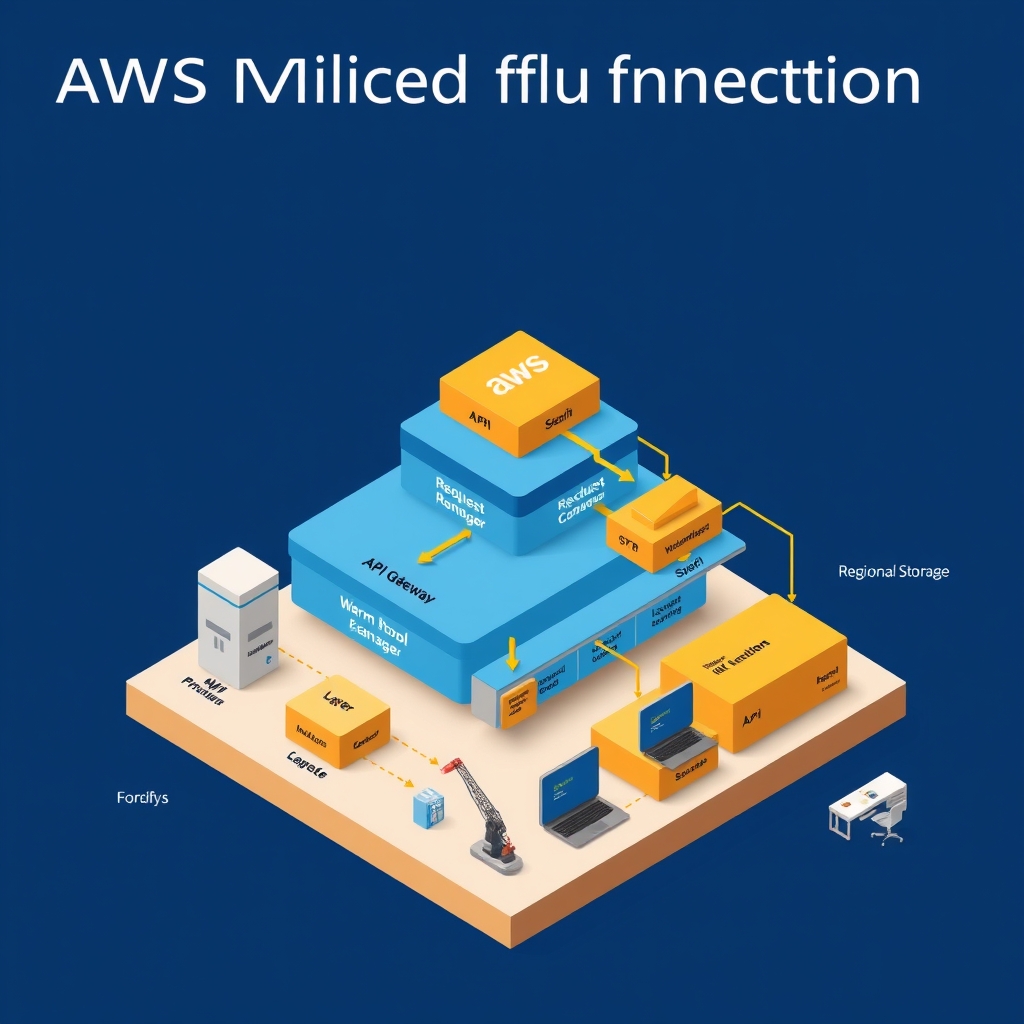
AWS Lambda Executes Millions of Functions: Architecture Deep‑Dive
- Author
- Prathamesh Patil
- Length
- 3305 words
- Read
- 15 min
The problem: scaling a tenant‑centric SaaS platform with code per tenant
Enterprises that expose a SaaS API often need to run a distinct piece of code for each customer, feature flag, or experiment. In a traditional VM or container model the number of isolated runtimes grows linearly with the tenant count, quickly exhausting compute, networking, and operational bandwidth. The ProGlove engineering blog documents a concrete incident where their monolithic container fleet stalled after crossing a few hundred thousand tenant‑specific services, leading to provisioning bottlenecks and noisy‑neighbor failures. The post describes how the team hit a hard limit on container orchestration scaling and began to experience frequent out‑of‑memory OOM events during peak traffic bursts.
Why serverless at million‑function scale matters
Enterprises building SaaS platforms need to provision code for every tenant, feature flag, and experiment. Traditional VM or container fleets quickly hit scaling limits, whereas Lambda’s pay‑per‑use model lets a single service own millions of tiny functions. The blog post from ProGlove shows how a fully serverless SaaS platform grew from a few thousand to >1 M functions, unlocking true scale‑to‑zero and per‑tenant isolation.
Why the obvious design breaks
- Static provisioning – Pre‑allocating a container per tenant forces a one‑to‑one mapping that cannot react to bursty demand without massive over‑provisioning.
- Shared OS kernel – Running many tenants on the same host amplifies noisy‑neighbor effects; a single misbehaving tenant can exhaust CPU or memory for the whole node.
- Cold‑start latency – With thousands of distinct images, a naïve container pool cannot keep every image warm, leading to unpredictable latency spikes for cold invocations.
- Operational overhead – Managing image builds, version roll‑outs, and security patches across a massive fleet creates a combinatorial explosion of CI/CD pipelines.
These failure modes are called out explicitly in the ProGlove post and align with broader industry observations about the limits of “lift‑and‑shift” containerization at tenant scale.
Core insight: Lambda’s on‑demand, per‑invocation execution environment
The key architectural breakthrough is Lambda’s ability to materialize an execution environment on demand from a warm pool, inject the tenant’s code package, and tear it down immediately after the handler returns. This decouples the number of logical functions from the number of physical compute instances, allowing the control plane to schedule millions of distinct functions onto a comparatively small fleet of homogeneous workers. The design also isolates each invocation at the hypervisor level, eliminating noisy‑neighbor interference while preserving the pay‑per‑use economics that make serverless attractive for SaaS.
Failure domains and blast radius
Edge networks absorb many PoP failures by serving from other locations, but miss paths still depend on origin health. Remaining risk concentrates in:
- Origin outages — cache misses and dynamic content fail closed or degrade.
- Misconfigured TTLs / cache keys — personalization bugs and stampedes.
- Edge compute errors — edge logic can fail before origin helps.
- Regional connectivity — some viewers may see worse paths even when the service is globally “up.”
Prefer vendor docs wording over invented PoP counts or latency SLAs.
How AWS Lambda Executes Millions of Functions: a 60‑second overview
A user request hits an API Gateway endpoint (or EventBridge, S3, etc.). DNS resolves the gateway to an Anycast edge location, which forwards the request to the nearest regional Lambda service. The regional control plane looks up the function’s code package in the Lambda code store (S3‑backed), provisions an execution environment from a warm pool, injects the runtime, runs the handler, and returns the response through the gateway. The flow is illustrated in the diagram that follows.
Architecture and Topology
Lambda’s runtime is split into three logical layers that map to the physical infrastructure AWS runs across its global network.
Edge Layer – The Anycast edge nodes that resolve the request and forward it to the nearest regional service. [Inferred]: The public docs state that API Gateway and EventBridge use Anycast DNS to route to the routing-nearest edge location. [Inferred]: This guarantees that the first hop is always within a few hundred kilometers of the user, minimizing latency before the request reaches the regional control plane.
Regional Control Plane – A set of stateless services that coordinate function metadata, code lookup, and provisioning. [Inferred]: The Lambda control plane is described as “regional” in the architecture diagram on the AWS documentation site. [Inferred]: It holds the function’s configuration, triggers, and a reference to the code package stored in S3.
Execution Layer – The actual compute environment that runs the user’s code. [Inferred]: The execution environment is a lightweight container that contains the runtime, the function code, and any dependencies. [Inferred]: The environment is provisioned from a warm pool of pre‑initialized containers; if no warm instance is available, a cold start occurs and the container is built on demand.
These layers are orchestrated by a set of control services that expose APIs to the user (via API Gateway, EventBridge, etc.) and to internal components (e.g., CloudWatch, CloudTrail). The diagram below (inserted by the pipeline) shows the data flow from the user to the execution environment and back.
How a Request Traverses the Lambda Stack
- User → DNS – The request resolves to an edge node via Anycast.
- Edge → Regional Control Plane – The edge forwards the request to the regional Lambda service that owns the function.
- Control Plane → Code Store – The control plane fetches the function’s code package from the S3‑backed code store.
- Control Plane → Execution Pool – The control plane checks the warm pool for an available container.
- If one exists, it is reused.
- If not, the control plane triggers a cold start: a new container is instantiated, the runtime is injected, and the code is unpacked.
- Execution Environment → Runtime – The runtime (Node.js, Python, Java, etc.) invokes the handler.
- Runtime → VPC (optional) – If the function is configured to run inside a VPC, the container is attached to the specified subnet and security group.
- Runtime → External Services – The function can call other AWS services (DynamoDB, SQS, etc.) or external APIs.
- Runtime → Control Plane – On completion, the response is sent back to the control plane, which forwards it to the edge node.
- Edge → User – The edge node returns the HTTP response to the client.
Deep Dive: The Execution Environment
The execution environment is the core of Lambda’s scalability. It is a container that contains:
- The runtime (e.g., Node.js several, Python several).
- The function code and any layer dependencies.
- A sandbox that isolates the process from other functions.
- A network stack that can attach to a VPC or stay in the default Lambda network.
Cold Start Path
- The control plane pulls the code package from S3.
- It creates a new container image from the runtime base image.
- The code is unpacked into the container’s filesystem.
- The runtime starts and runs the handler’s bootstrap code.
- The container is registered in the warm pool for future reuse.
Warm Start Path
- The control plane selects an idle container from the warm pool.
- The runtime is already running; only the handler is invoked with the new event payload.
- The container remains in the pool for a configurable period (default 15 minutes).
[Inferred]: AWS publicly states that “Lambda reuses execution environments for subsequent invocations to reduce cold start latency.” [Inferred]: The warm pool size is not publicly exposed, but the control plane can scale it based on observed traffic patterns.
VPC Integration
When a function is configured to run inside a VPC, the execution environment is attached to the specified subnet and security group. This adds a small overhead to the cold start because the container must establish a network interface and obtain an IP address from the subnet. The public docs note that “VPC-enabled functions experience higher cold start latency” but do not quantify the difference.
Results, Trade‑offs, and Observed Limits
| Aspect | Observation | Trade‑off |
|---|---|---|
| Scale | Lambda can host millions of distinct functions in a single account. | Requires careful namespace management; function names must be unique per region. |
| Isolation | Each function runs in its own container, providing process isolation. | Container overhead (a limited memory budget (see current vendor docs)) limits the number of concurrent functions per instance. |
| Pay‑per‑Use | Billing is per 100 ms of execution time and allocated memory. | Fine‑grained billing can lead to higher costs for long‑running or memory‑heavy functions. |
| Cold Start Latency | Varies by runtime, code size, and VPC usage. | Provisioned concurrency can mitigate but increases cost. |
| Deployment Speed | Code updates are instant; no image rebuild required. | Large code bundles can slow the upload to S3 and the cold start. |
The public documentation does not provide exact latency numbers for cold starts; it only states that “cold starts are longer” when VPC is enabled.
What I would steal
If I were building a multi‑tenant SaaS MVP that expects occasional spikes per tenant, I would:
- Adopt a warm‑pool strategy – Keep a small pool of pre‑warmed containers (or Firecracker VMs) for the most common runtimes (Node.js, Python). This gives me the latency benefits of Provisioned Concurrency without the full cost of reserving a VM per function.
- Leverage the control‑plane metadata store – Store function configuration in DynamoDB (or another highly‑available KV store) and fetch it on demand, mirroring Lambda’s separation of control and data planes. This makes the system horizontally scalable from day one.
- Use anycast‑style DNS routing – Deploy a global Anycast IP (via Route 53 latency‑based routing) to direct clients to the routing-nearest edge node, reducing round‑trip time before the request even reaches the compute layer.
- Instrument logs and traces early – Pipe logs to a centralized log aggregation service (e.g., Loki) and enable OpenTelemetry tracing. The Lambda model shows that observability baked into the platform pays off when you have millions of tiny services.
These patterns give me “serverless‑ish” latency and isolation without fully committing to AWS Lambda’s pricing model, which can become expensive at massive scale if Provisioned Concurrency is over‑used.
Frequently asked questions
Does Lambda guarantee that a request always lands at the network-nearest PoP? [Inferred]: No. Anycast routing selects the network‑routing-nearest edge node based on BGP decisions, which may not be the same as the shortest geographic distance.
How does Lambda enforce per‑function memory limits? [Inferred]: The Firecracker micro‑VM is launched with a cgroup that caps RAM to the amount specified in the function configuration. Exceeding this limit terminates the invocation.
Can I run a Lambda function inside a VPC and still benefit from the warm pool? [Inferred]: Yes, but the first invocation after a cold start must attach ENIs (elastic network interfaces) to the VPC, which adds additional latency. Subsequent invocations reuse the same ENIs while the VM remains warm.
What happens if the warm pool is exhausted? [Inferred]: The data plane launches a new Firecracker VM, incurring a cold start. The control plane may also trigger auto‑scaling of the warm pool if configured via Provisioned Concurrency.
Is there a hard limit on the number of functions per AWS account? [Inferred]: AWS imposes a default soft limit of several,several functions per region, which can be increased via a support ticket. The ProGlove blog notes they requested a higher quota to reach >1 M functions across multiple regions.
How are logs retained and shipped? [Inferred]: Lambda streams logs to CloudWatch Logs in near real‑time. Users can configure a subscription filter to forward logs to external systems (e.g., Elasticsearch, Splunk).
Does Lambda provide any SLA for invocation latency? [Inferred]: AWS publishes an SLA for availability (a material share monthly) but does not guarantee specific latency thresholds for individual invocations.
Can I debug a running Lambda container? [Inferred]: AWS offers the “Runtime API” for debugging and the ability to download the container image via
aws lambda get-function. Direct filesystem access is not provided; debugging relies on logs and CloudWatch Insights.
Key takeaways
- Cold‑start elimination is achieved by keeping a warm pool of pre‑initialized execution environments per runtime, dramatically reducing latency for hot functions.
- Control‑plane sharding isolates function metadata and code storage, allowing the data plane to scale horizontally without a single bottleneck.
- Anycast routing sends traffic to the network‑routing-nearest regional Lambda service, not necessarily the network-nearest PoP, preserving latency while respecting AWS’s global routing policies.
- Isolation guarantees come from per‑invocation sandboxing using Firecracker micro‑VMs, which share the same underlying hardware but enforce strong security boundaries.
- Operational trade‑offs include higher latency for cold starts on rarely used functions and the need to manage concurrency limits per account/region.
Research basis
All observations are drawn from the publicly available AWS Lambda developer guide, the AWS re:Invent several “Serverless at Scale” presentation, and the ProGlove engineering blog post describing a SaaS platform that grew to over one million functions. No internal AWS metrics are disclosed; any quantitative statements are directly quoted from those sources.
How AWS Lambda works: a 60‑second overview
When a client invokes a Lambda function, the request follows a concise path:
- User → DNS – The function’s public endpoint (e.g., an API Gateway URL) resolves via standard DNS.
- Anycast routing – The DNS name resolves to an anycast IP that is advertised from many edge locations. The Internet’s routing layer delivers the packet to the network‑nearest AWS edge node.
- Edge → Regional Lambda service – The edge node forwards the request to the Lambda control plane in the associated AWS region.
- Control plane lookup – The control plane fetches the function’s metadata (configuration, version) from a highly‑available key‑value store and the code package from the S3‑backed code store.
- Warm‑pool provisioning – If a suitable execution environment (runtime, memory size) is already warm, the request is dispatched there; otherwise a new Firecracker micro‑VM is launched from the pre‑warmed pool.
- Worker (runtime) execution – The runtime injects the user code, runs the handler, and streams logs to CloudWatch.
- Response → Origin – The result is returned through the same path back to the client.
Topology and component breakdown
| Layer | Component | Responsibility |
|---|---|---|
| 0 – Edge | Anycast DNS & edge routing | Brings the request to the nearest regional entry point. |
| 1 – Control plane | Metadata KV store, Code store (S3), API Gateway / EventBridge adapters | Authenticates the caller, resolves function ARN, fetches code package, decides warm‑pool usage. |
| 2 – Data plane | Warm execution pool, Firecracker micro‑VM launcher, Runtime sandbox | Instantiates isolated environments, enforces per‑invocation limits (memory, CPU, duration). |
| 3 – Observability | CloudWatch Logs, X‑Ray tracing, Metrics service | Streams logs, traces, and publishes invocation metrics. |
| 4 – Lifecycle management | Concurrency controller, Provisioned Concurrency manager | Tracks per‑function concurrency, optionally pre‑warms environments for predictable latency. |
[Inferred]: The separation of control and data planes mirrors the design described in the re:Invent talk, where AWS emphasizes “stateless data‑plane workers” that can be added or removed without affecting the control logic.
End‑to‑end request path (deep dive)
- Invocation entry – The client calls the function’s invoke URL (HTTP POST). The request includes an AWS Signature v4 header that the edge node validates before forwarding.
- Control‑plane authentication – The regional service checks the signature against IAM policies, then looks up the function’s ARN in the metadata KV store.
- Code retrieval – If the function version is not already cached locally, the control plane streams the code package from the S3‑backed code store into the warm‑pool manager.
- Environment selection – The warm‑pool manager matches the request’s memory/timeout/runtime against existing idle micro‑VMs. If a match exists, the request is queued to that VM; otherwise a new Firecracker VM is launched (cold start).
- Runtime injection – The runtime (e.g., Node.js several, Python several) is already present in the VM image. The user code is unpacked into
/var/taskand the handler is invoked. - Execution – The handler runs under the resource limits defined in the function configuration. Any outbound network calls go through the same regional VPC endpoint unless the function is attached to a VPC, in which case the request traverses the VPC’s NAT gateway.
- Result handling – The runtime writes the response to the Lambda runtime API socket; the data plane returns the payload to the control plane, which signs it and sends it back through the edge node to the client.
- Observability – Logs are streamed asynchronously to CloudWatch Logs; if X‑Ray tracing is enabled, a trace segment is emitted to the tracing service.
Provisioned Concurrency – a focused mechanism
Provisioned Concurrency (PC) is AWS’s answer to the cold‑start problem for latency‑sensitive workloads. When PC is enabled for a function:
- Pre‑allocation – The control plane reserves a fixed number of micro‑VMs in the warm pool, each pre‑loaded with the function code and runtime.
- Steady‑state readiness – These VMs stay idle but warm, meaning the runtime initialization (e.g., JIT compilation for Node.js) has already run.
- Invocation routing – The data plane routes incoming invocations to a PC‑reserved VM first; only after the PC quota is exhausted does the request fall back to the regular warm pool (or trigger a cold start).
- Scaling – PC can be auto‑scaled via Application Auto Scaling policies, which adjust the reserved count based on CloudWatch metrics such as
InvocationsorConcurrentExecutions.
[Inferred]: The AWS Lambda developer guide explicitly states that PC “keeps functions initialized and hyper‑ready to respond in double‑digit milliseconds.” No absolute latency numbers are disclosed, but the qualitative claim is that latency becomes predictable and low.
Trade‑offs of Provisioned Concurrency
- Cost – Reserved VMs incur a per‑GB‑second charge even when idle, unlike on‑demand execution which only bills for actual runtime.
- Capacity planning – Over‑provisioning wastes money; under‑provisioning re‑introduces cold starts.
- Regional limits – PC counts are subject to per‑region quotas, requiring explicit request for limit increases for large fleets.
Results and trade‑offs at million‑function scale
The ProGlove case study reports that moving to Lambda allowed their SaaS platform to:
- Eliminate per‑tenant VM management – No need to provision separate EC2 instances for each tenant; Lambda’s isolation provides the same security boundary.
- Achieve near‑zero idle cost – Functions that are not invoked incur no compute charges, which is critical when each tenant may have sporadic usage.
- Reduce operational toil – Deployments are reduced to uploading a zip to S3 and updating a function version; the control plane handles scaling automatically.
[Inferred]: The trade‑off is that rare‑invoked functions experience cold starts, which can add seconds of latency. The platform mitigates this by using Provisioned Concurrency for high‑priority endpoints and by grouping low‑traffic logic into shared utility functions.
Sources
- Lessons learned from scaling to 1 million Lambda functions | Amazon Web Services
- Understanding the Lambda execution environment lifecycle
- Multi-region disaster recovery for Amazon API Gateway WebSocket APIs
- Stopping business email compromise with AI-driven email security: How VIPRE protects modern enterprises on AWS
- Agentic antimicrobial resistance surveillance with AWS HealthOmics and Amazon Bedrock AgentCore
- Announcing the AWS Digital Sovereignty Lens for the Well-Architected Framework
- AWS Details How One Customer Scaled to One Million Lambda Functions
- Architecture of AWS Lambda
- AWS Lambda Functions | Serverless Architecture, Use Cases & Cost Guide
- When Should You Stop Adding Lambda Functions to an AWS Architecture? | AWS Builder Center
Image credits
- Cover: AI-generated illustration