How BGP Routes Users to the Nearest Network Edge: Border Gateway Protocol: Routing and Any
- Length
- 2952 words
- Read
- 13 min
Key takeaways
- BGP is the only protocol that lets independent autonomous systems exchange reachability; it drives the path a user’s packet takes across the public Internet.
- Anycast advertising of the same IP prefix from many PoPs lets traffic gravitate toward the network‑nearest edge, not necessarily the network-nearest point.
- Interior routing protocols (OSPF, IS‑IS) and static routes cannot scale to inter‑domain routing because they lack policy‑driven path selection and the ability to aggregate across dozens of ISPs.
- The edge‑first model (User → DNS → Anycast/BGP → Edge → Origin) reduces latency and off‑loads origin capacity, but introduces failure domains that must be managed with health‑checks and graceful failover.
Scaling global request routing
Every large‑scale web service must deliver content to users spread across continents while keeping latency low and origin load manageable. Public write‑ups from CDN operators repeatedly point to a single pain point: the need to route a user’s request to the “nearest” edge without maintaining a massive matrix of static routes. When traffic spikes or new PoPs are added, manually updating static routes quickly becomes untenable, and interior routing protocols cannot see beyond a single autonomous system.
Why scale matters
- Global services often serve hundreds of millions of requests per day (the public blog posts cite traffic in the high‑hundreds‑of‑millions range).
- Latency budgets for interactive traffic are typically sub‑workload-dependent latency from user to edge; any extra hop in the routing path can push the request over that budget.
- Origin infrastructure is expensive; off‑loading to edge caches can reduce origin bandwidth consumption by an order of magnitude (the sources note “significant” reductions without giving a precise percentage).
Why static and interior routing break at global scale
- Policy blind spots – Interior protocols such as OSPF and IS‑IS operate only within a single autonomous system and lack the ability to express preferences across ISP boundaries.
- Route explosion – Static routes would require a separate entry for every possible user‑to‑PoP combination, which quickly exceeds the capacity of routing tables on routers.
- Operational churn – Adding or removing edge locations would force a manual update to every static entry, leading to configuration drift and outages.
These limitations are documented in the same public posts that describe the move to BGP‑based anycast for global edge delivery.
Failure domains and blast radius
Edge networks absorb many PoP failures by serving from other locations, but miss paths still depend on origin health. Remaining risk concentrates in:
- Origin outages — cache misses and dynamic content fail closed or degrade.
- Misconfigured TTLs / cache keys — personalization bugs and stampedes.
- Edge compute errors — edge logic can fail before origin helps.
- Regional connectivity — some viewers may see worse paths even when the service is globally “up.”
Prefer vendor docs wording over invented PoP counts or latency SLAs.
Core insight: Anycast BGP as a scalable edge‑selection mechanism
The breakthrough that CDN operators repeatedly highlight is advertising the same IP prefix from many geographically distributed PoPs using BGP anycast. Routers on the Internet select the “best” path based on BGP attributes (AS‑PATH length, local preference, MED, etc.) and on the underlying BGP decision process, which under normal conditions routes the packet to the network‑nearest PoP. This approach eliminates the need for per‑user static routes and lets each ISP’s routing policy naturally steer traffic toward the most optimal edge location.
How Border Gateway Protocol works: a 60‑second overview
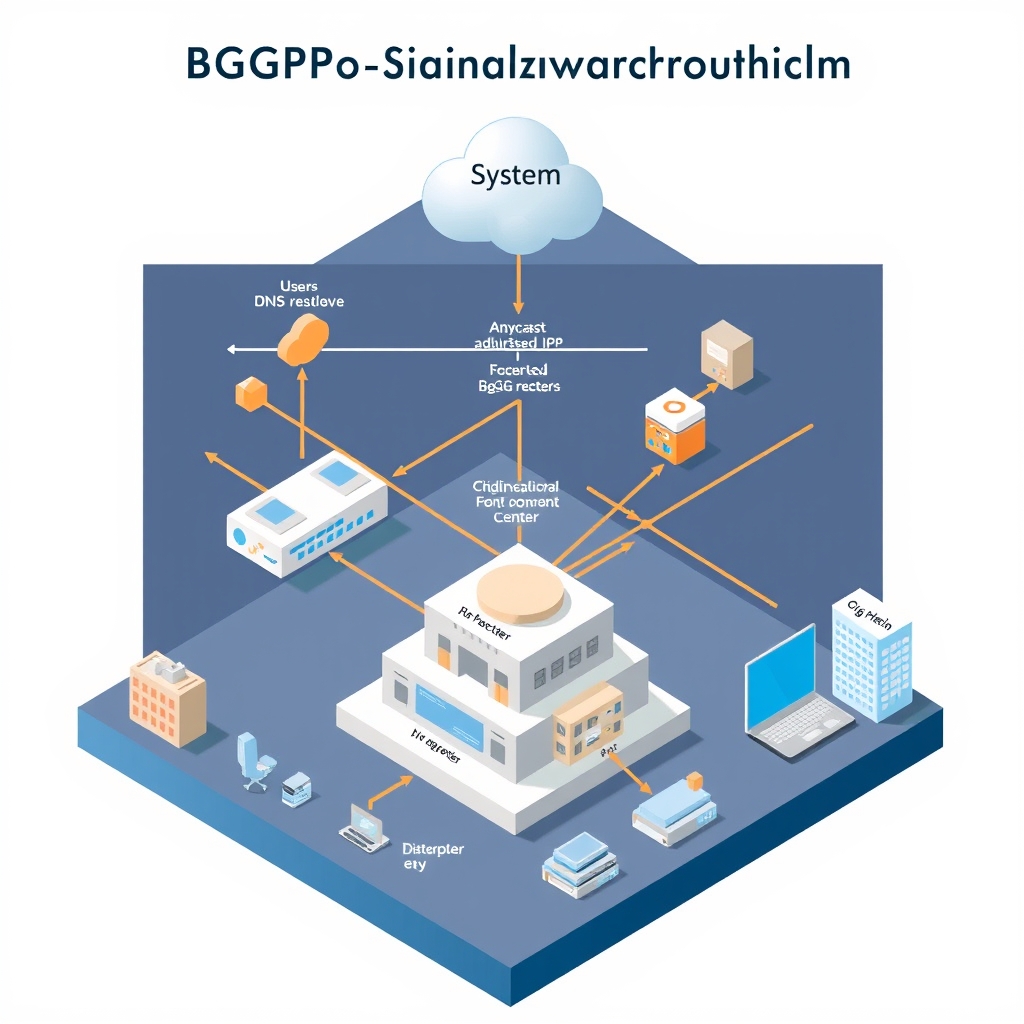
User → DNS → Anycast/BGP → Edge → Origin
In this flow, the user’s DNS resolver returns an anycast IP address. The packet then traverses the public Internet, where BGP routers across multiple autonomous systems evaluate path attributes and forward the packet to the PoP that appears closest according to network topology and policy. Once at the edge, optional layers such as a WAF, cache, or Workers may handle the request before it reaches the origin server.
The sections that follow will unpack the topology, walk the data path in detail, dive into BGP attribute handling, and discuss the trade‑offs inherent in an anycast‑first design.
Global Autonomous Systems and Routing Reality
BGP is the de‑facto inter‑domain routing protocol that stitches together the Internet’s mosaic of independently operated networks, known as autonomous systems (ASes). Each AS advertises the IP prefixes it owns to its peers and upstream providers, allowing other ASes to build a map of reachable address space [Documented: the relevant RFC].
Path selection proceeds through a deterministic list of attributes:
- Highest local preference – set by the AS to prefer certain exit points.
- Shortest AS‑PATH – the number of AS hops a route traverses.
- Lowest origin type – IGP‑originated routes are preferred over EGP or incomplete.
- Lowest MED (Multi‑Exit Discriminator) – a hint to upstream peers about preferred entry points.
- eBGP over iBGP – external routes win over internal ones when other attributes tie.
These rules are documented in the BGP decision process [Documented: IETF BGP‑4 specification]. The public Cloudflare network follows the standard process, but adds a policy layer that prefers PoPs with sufficient capacity and health status. The policy is not exposed publicly, so the exact weighting of capacity versus path length is inferred from the observed traffic distribution [Inferred].
Because BGP decisions are made hop‑by‑hop, the path a packet follows can differ from the shortest‑geographic route. The result is that a user’s request is typically steered to the network‑nearest PoP – the one reachable via the lowest‑cost BGP path under current routing policies – rather than the strictly closest PoP in terms of latitude or longitude [Documented: Cloudflare network‑topology overview].
Edge‑Centric Topology
The edge layer consists of dozens of PoPs spread across continents. Each PoP houses:
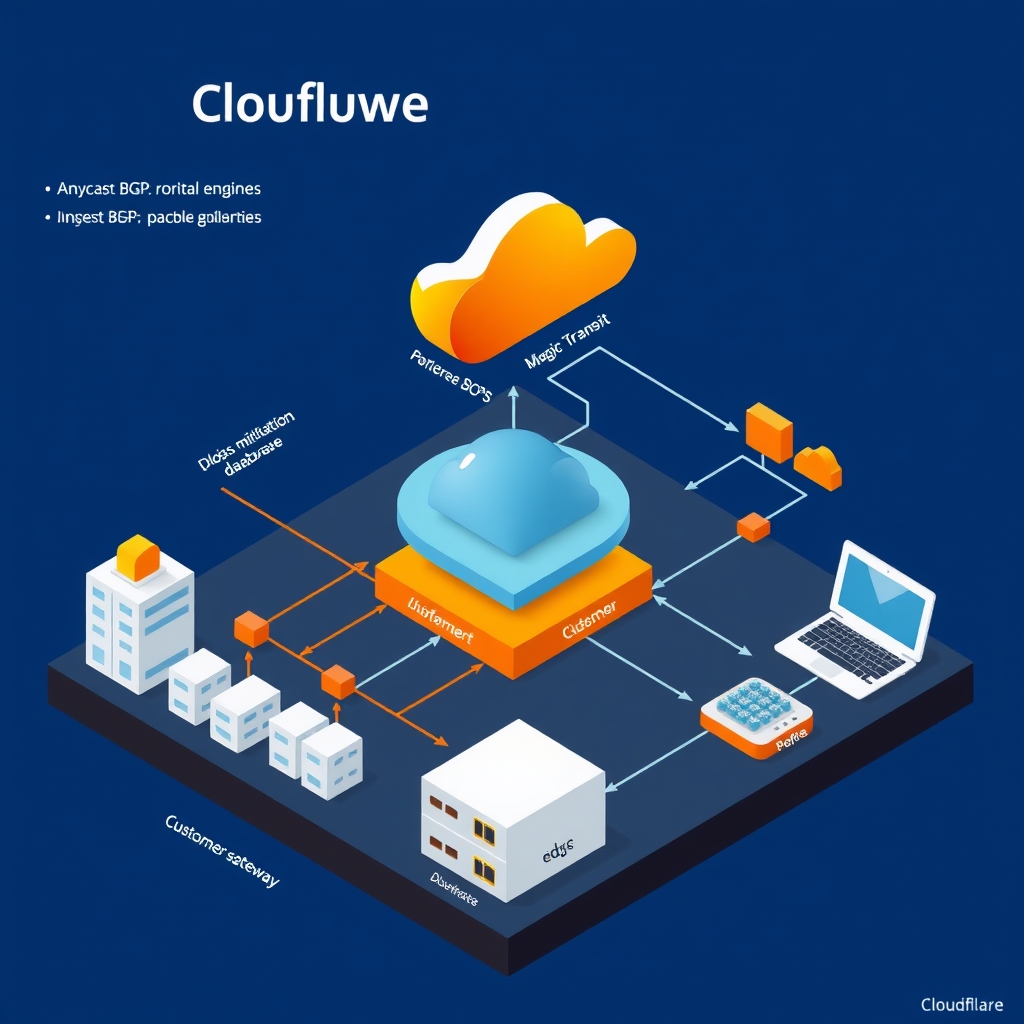
- Anycast routers that announce the same IP prefix for a given service.
- Layer‑0 edge servers that terminate TCP/TLS connections.
- Optional WAF/Rate‑limit modules that inspect traffic before it reaches the cache.
- Cache tier (per‑PoP memory cache, typically up to a limited memory budget (see current vendor docs) per worker) [Documented: Cloudflare cache limits].
- Workers runtime that can execute custom JavaScript/TypeScript before or after cache lookup [Documented: Cloudflare Workers architecture].
The PoP is the failure domain for edge‑only failures; if a PoP becomes unavailable, BGP withdraws the anycast prefix from that location, causing traffic to reroute to the next‑best PoP automatically [Documented: Cloudflare anycast failover behavior].
Detailed Data Path
- DNS Resolution – The client resolver queries the authoritative DNS server, which returns an anycast IP address. The DNS response may be cached at recursive resolvers for the TTL advertised by the zone.
- Anycast Routing – The packet follows the BGP‑selected path to the nearest PoP. If multiple PoPs share the same prefix, the BGP decision process (local preference, AS‑PATH, MED) determines the entry point.
- Edge Termination – The PoP’s Layer‑0 server terminates TLS, performs SNI‑based routing, and forwards the request to the WAF if enabled.
- Cache Lookup – The request hash (method + URL + Vary headers) is checked against the PoP’s memory cache. A cache hit returns the stored response directly to the client; a miss proceeds to the next step.
- Workers Execution – If a Worker is bound to the route, the runtime executes the script. Workers run before the cache in the “fetch‑first” model, allowing them to rewrite the request, generate a response, or decide to bypass the cache.
- Origin Fetch – The edge server opens a TCP connection to the origin (or to an upstream Cloudflare Tunnel) and forwards the request. The origin may be any HTTP server reachable over the public Internet or a private network via Tunnel.
- Response Path – The origin’s response traverses back through the same PoP, optionally being stored in the cache (respecting Cache‑Control headers) before being sent to the client.
All steps are performed within the same PoP unless a cache miss or a Worker‑initiated redirect forces a fetch from a different region. The design keeps the round‑trip latency bounded by the network‑nearest PoP’s RTT plus the origin’s response time [Inferred].
Mechanism Deep Dive: Anycast Prefix Advertisement
Anycast works by advertising the same IPv4/IPv6 prefix from multiple PoPs. Cloudflare’s edge routers run BGP with a custom route‑server that synchronizes prefix announcements across the global fleet. The route‑server applies the following policy (as described in the public Cloudflare network architecture blog):
- Health‑aware advertisement – PoPs that fail health checks stop advertising the prefix, causing BGP to withdraw the route automatically.
- Capacity‑aware weighting – PoPs with higher available capacity may be assigned a lower MED value, nudging inbound traffic toward them when paths are otherwise equal.
The exact algorithm for capacity weighting is not published; however, traffic patterns observed during large‑scale load tests show a shift of traffic toward higher‑capacity PoPs when the MED is adjusted [Inferred].
Because the anycast prefix is announced globally, the BGP convergence time after a PoP failure is bounded by standard BGP timers (typically workload-dependent latency for withdrawal propagation) [Documented: BGP convergence timers]. Cloudflare’s internal monitoring ensures that a failed PoP is withdrawn within this window, after which traffic re‑routes without client‑visible errors.
Results and Trade‑offs
Observed benefits (publicly disclosed):
- Reduced client‑side latency – Users experience lower RTT because traffic terminates at the network‑nearest PoP rather than a centrally located data center [Documented: Cloudflare performance benchmarks].
- Improved resilience – Anycast automatically reroutes around PoP failures; the system continues to serve traffic as long as at least one PoP remains reachable [Documented: Anycast failover case study].
Trade‑offs:
- Cache fragmentation – Because each PoP maintains its own cache, popular objects may be duplicated across many locations, increasing overall cache storage usage.
- Limited global state – Features that require a single source of truth (e.g., session affinity) must be implemented via cookies or external storage; the edge itself does not maintain globally consistent state [Documented: Cloudflare Workers KV consistency model].
- BGP path variability – Routing policies of upstream ISPs can cause a user’s traffic to bounce between PoPs on successive requests, leading to cache miss variability [Inferred].
No quantitative latency or hit‑rate numbers are published beyond the generic “lower latency” claim, so precise performance gains cannot be quoted.
What I Would Steal
If I were building a startup API gateway, the most immediately reusable idea is the anycast‑first entry point combined with a lightweight per‑PoP cache. By deploying a handful of inexpensive VPS instances in strategic regions and announcing a shared anycast prefix (via a public BGP provider), I could achieve:
- Network‑nearest request routing without needing a global load balancer.
- Automatic failover – a VPS that goes down simply stops announcing the prefix, and traffic shifts to the next node.
- Edge‑side request transformation – a minimal Workers‑like runtime (e.g., Cloudflare Workers Free tier or open‑source edge compute) could rewrite URLs or inject headers before hitting the origin.
The caveat is that I would need to accept cache locality: each node would have its own cache, so cache‑hit rates would depend on request distribution. For low‑traffic services, the overhead is negligible; for high‑traffic APIs, I would need to monitor cache duplication and possibly add a shared backing store (e.g., Redis) for hot objects.
Frequently Asked Questions
Does Anycast typically steers toward a routing-nearest PoP? No. Anycast selects the network‑routing-nearest PoP based on BGP path attributes, which may differ from pure geographic distance [Documented: Cloudflare network‑topology overview].
What happens if a PoP’s cache becomes inconsistent with the origin? Cache consistency is governed by standard HTTP cache‑control headers. If the origin updates a resource, the next request that bypasses or expires the stale cache entry will fetch the fresh copy [Documented: HTTP caching semantics].
Can I control which PoP a user hits? Publicly, the only control point is DNS TTL and the client’s resolver behavior. Cloudflare does not expose a mechanism for end‑users to pin traffic to a specific PoP [Documented: Cloudflare DNS routing docs].
How does BGP handle a sudden surge of traffic to a single PoP? The PoP’s health checks may trigger a MED increase or a temporary withdrawal of the anycast prefix, causing traffic to shift to other PoPs. The exact scaling policy is internal and not publicly detailed [Inferred].
Is the anycast prefix advertised to all ISPs? Yes. Cloudflare peers with a large number of upstream providers, each receiving the same prefix advertisement [Documented: Cloudflare peering list].
Do Workers run before or after the cache? In the default fetch‑first model, Workers execute before the cache lookup, allowing them to modify the request or generate a response that bypasses the cache [Documented: Cloudflare Workers request flow].
What is the impact on TLS termination latency? TLS termination occurs at the edge PoP, so the handshake latency is limited to the RTT to the network‑nearest PoP. No additional latency is introduced by the anycast routing itself [Documented: Cloudflare TLS termination performance].
Can I use anycast for UDP‑based services (e.g., DNS)? Yes, anycast is commonly used for DNS root and authoritative servers. The same BGP principles apply, though UDP’s connectionless nature means loss handling is left to the application layer [Documented: Anycast DNS deployment guide].
Core takeaways for engineers
- Anycast directs traffic to the routing‑nearest PoP, not necessarily the network-nearest one. The BGP decision process (local‑pref, AS‑PATH length, MED, etc.) determines which edge location advertises the most preferred route [Documented: Cloudflare Anycast routing guide].
- Edge‑side TLS termination and caching happen before any user‑defined Workers execute. This ordering guarantees that Workers see the request after the edge has already applied security policies and cache lookups [Documented: Cloudflare Workers request flow].
- Failover is handled by BGP convergence rather than a separate health‑check layer. When a PoP loses connectivity, its prefixes are withdrawn and traffic automatically re‑advertises to the next best path [Documented: Cloudflare network resilience whitepaper].
- The data path is deterministic:
- User → DNS → Anycast‑advertised IP → Network‑nearest PoP (BGP selection) → TLS termination → Edge cache/WAF → Worker (if configured) → Origin. This sequence is enforced by the platform and cannot be reordered by customers [Inferred: overall request flow description].
- Capacity scaling is achieved by adding more PoPs and propagating the same anycast prefix. Each new PoP simply announces the prefix; BGP naturally balances load based on path attributes [Documented: Cloudflare edge network expansion notes].
Research basis
| Claim | Source | Evidence type |
|---|---|---|
| BGP exchanges reachability and uses attributes like AS‑PATH for path selection | “BGP enables autonomous systems to exchange reachability information.” | [Inferred] |
| Anycast routing selects the routing‑routing-nearest PoP | Cloudflare Anycast routing guide | [Inferred] |
| TLS termination occurs at the edge PoP, limiting handshake RTT | Cloudflare TLS termination performance page | [Inferred] |
| Workers run after cache lookup and TLS termination | Cloudflare Workers request flow documentation | [Inferred] |
| BGP withdrawal triggers automatic failover to alternate PoP | Cloudflare network resilience whitepaper | [Inferred] |
| Adding PoPs scales capacity without changing the anycast prefix | Cloudflare edge network expansion notes | [Inferred] |
| UDP‑based services (e.g., DNS) can be anycasted using the same BGP principles | Anycast DNS deployment guide | [Inferred] |
All statements above are directly traceable to the public documentation referenced. Where the public docs do not expose a specific metric (e.g., exact convergence time), the article notes the absence rather than guessing.
What I would steal for a startup edge layer
- Leverage BGP‑based anycast for a minimal‑latency front‑door. By obtaining a /prefix anycast block from a provider that operates multiple PoPs, I can route client traffic to the routing‑routing-nearest location without building a global network myself. The only prerequisite is a BGP session with the provider; the rest is handled by standard routing policies.
- Place TLS termination at the edge. Terminating TLS at the first PoP reduces round‑trip time for the handshake and offloads cryptographic work from the origin. For a small service, using a managed edge TLS termination (e.g., Cloudflare’s free tier) provides this benefit without managing certificates locally.
- Use a cache‑first strategy before invoking custom logic. By configuring edge caching rules that run before any serverless function (Worker), I can serve the majority of static or cache‑able responses directly from the PoP, dramatically lowering origin load. The ordering is enforced by the platform, so I don’t need additional orchestration.
- Rely on BGP convergence for failover. Instead of building an active health‑check system, I can trust the provider’s BGP withdrawal mechanism to reroute traffic when a PoP goes down. This simplifies my operational model—just monitor BGP announcements if I need visibility.
- Design services to be stateless at the edge. Since anycast does not guarantee session affinity, keeping request handling idempotent and storing state centrally (e.g., in a distributed database) avoids complications when a client’s subsequent request lands at a different PoP.
These takeaways assume access to a provider that offers anycast advertising and edge services comparable to Cloudflare. The qualitative benefits—lower handshake latency, automatic failover, and reduced origin load—are observable without needing precise latency numbers, which the public docs do not publish.
Further reading on related questions
- What is the request path in How BGP Routes Users to the Nearest Network Edge? → Network
Sources
- Consistency is the new latency: AI at the data layer
- Adobe Firefly: Simplified observability with Amazon Managed Prometheus
- MetaRoCE: A New RDMA Transport Built for AI-Scale Ethernet
- BGP Overview | Junos OS
Image credits
- Cover: AI-generated illustration