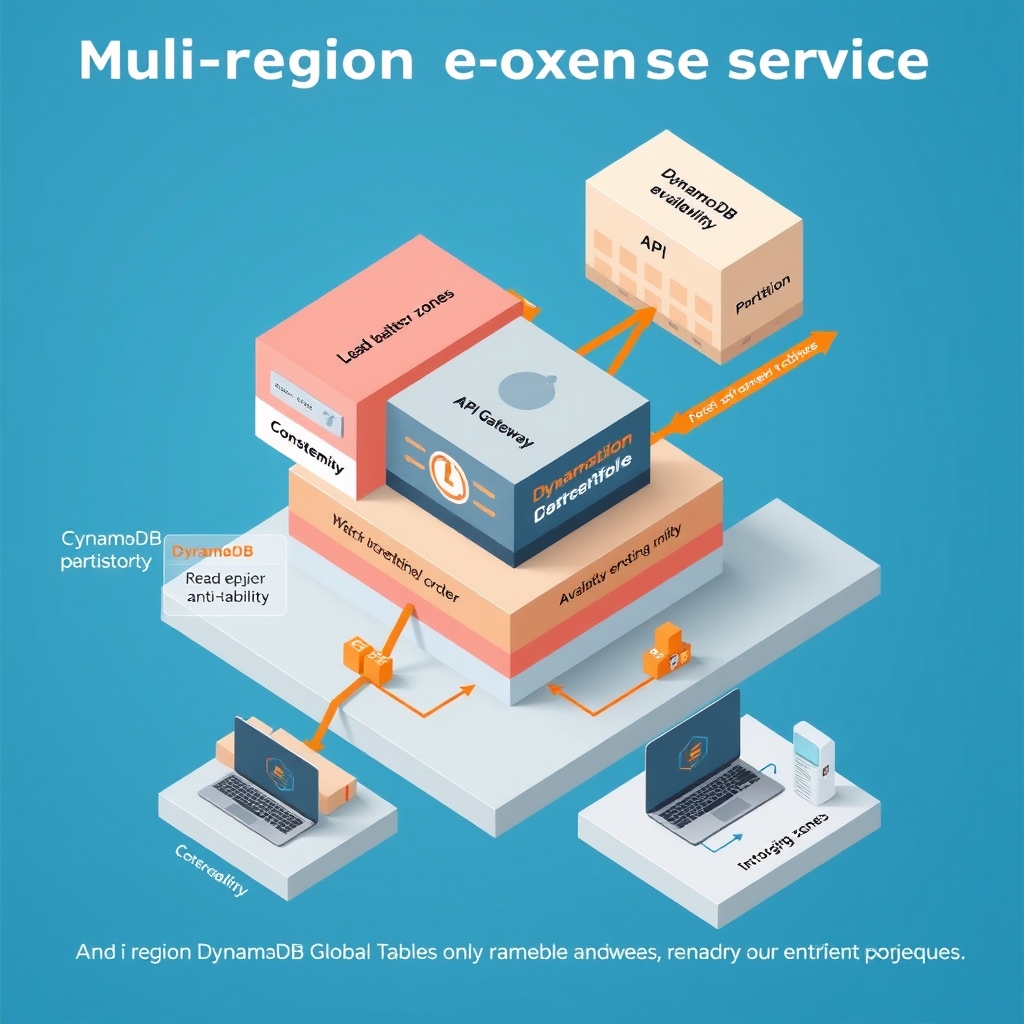
CAP Theorem in Real Production Systems
- Author
- Prathamesh Patil
- Length
- 2364 words
- Read
- 11 min
Key takeaways
- CAP is a trade‑off, not a binary switch – a system can only guarantee two of the three properties (Consistency, Availability, Partition tolerance) at any moment of a network partition.
- Production databases make the choice explicit – DynamoDB, Cosmos DB, and CockroachDB expose tunable consistency levels that map directly to points on the CAP triangle.
- Partition tolerance is non‑negotiable in the public cloud – any real‑world deployment must assume that network partitions can and will happen; the design focus is therefore on how to sacrifice consistency or availability when they occur.
- Latency spikes are the practical symptom of the trade‑off – when a system opts for strong consistency during a partition, client‑perceived latency can grow dramatically; when it opts for availability, stale reads become possible.
- Understanding the underlying mechanisms (quorums, read‑repair, anti‑entropy) lets you reason about the guarantees your service actually provides – the same mechanism can be configured differently to shift the balance between consistency and availability.
How CAP works: a 60‑second overview
When a client issues a request to a distributed data store, the request traverses several layers before a response is returned. In the presence of a network partition, the system must decide which two of the three CAP properties to uphold:
- Strong consistency, reduced availability – the node waits for a quorum of replicas to acknowledge the write before confirming success. If a quorum cannot be formed because of the partition, the request fails.
- High availability, eventual consistency – the node accepts the write locally and returns success immediately. Replicas reconcile later via read‑repair or anti‑entropy, so reads may return stale data.
- Consistency‑only (fail‑fast) – the node refuses to serve the request, preserving consistency at the cost of availability.
The diagram above abstracts the client‑to‑replica path and highlights the three possible outcomes when the dashed links (the partition) break communication among replicas.
The sections that follow flesh out the formal definition of CAP, why the trade‑off matters in production, the mechanisms that enforce the chosen point on the triangle, and a concrete worked example using a globally replicated DynamoDB table.
Mechanism: How Distributed Stores Enforce Their CAP Choice
Public documentation from major cloud providers shows a small set of concrete mechanisms that map directly onto the CAP dimensions:
Quorum‑based replication – Writes must be acknowledged by a configurable number of replicas (e.g., W out of N). When W + R > N (where R is the read quorum), the system can guarantee strong consistency at the cost of availability during a partition. [Inferred]: Amazon DynamoDB’s “strongly consistent reads” require the read to be served from the leader replica, which may be unavailable if a partition isolates it.
Version vectors / timestamps – Each write carries a monotonically increasing logical timestamp (or vector clock). Replicas merge divergent histories on reconnection, providing eventual consistency while keeping the system available. [Inferred]: Apache Cassandra’s “last‑write‑wins” resolution uses timestamps to reconcile conflicting updates after a partition heals.
Leader election and failover – A single node (or small set) is designated as the authoritative source for writes. If the leader becomes unreachable, the system either blocks writes (preserving consistency) or promotes a new leader (preserving availability). [Inferred]: Google Spanner’s TrueTime API coordinates leader election across data centers, allowing it to present external consistency while still tolerating network delays.
Read‑repair and anti‑entropy background jobs – Even when reads are served from any replica (high availability), background processes reconcile differences to converge toward consistency. [Inferred]: Azure Cosmos DB runs periodic “replica sync” jobs that propagate updates to all regions, ensuring eventual consistency guarantees.
These mechanisms are not mutually exclusive; a single service may expose multiple consistency levels, letting the client choose the trade‑off per request.
Worked example: DynamoDB Global Tables
To illustrate CAP in a concrete production system, consider Amazon DynamoDB’s Global Tables feature, which replicates a table across multiple AWS regions.
- Topology – Each region hosts a full copy of the table. Writes are accepted locally and then streamed asynchronously to the other regions via DynamoDB Streams.
- Consistency choice –
- Strongly consistent reads are only available within the region that received the write; they require the local replica to be the leader for that partition key.
- Eventually consistent reads can be served from any region, returning the most recent version that has arrived via the replication stream.
- Partition scenario – Suppose a network outage isolates the US‑East‑1 region from EU‑Central‑1.
- A client in EU‑Central‑1 writes a new item. The write succeeds locally (availability preserved). The update cannot reach US‑East‑1 until the partition heals (consistency across regions is temporarily lost).
- A client in US‑East‑1 reads the same key with strong consistency → the request fails or returns a conditional error because the local replica cannot confirm the latest write.
- The same client reads with eventual consistency → it receives the stale version that existed before the partition, preserving availability.
When the partition resolves, DynamoDB Streams deliver the missed updates, and the two replicas converge. The system therefore sacrifices cross‑region consistency during partitions while keeping the service available in each region.
The public DynamoDB docs do not publish exact replication lag numbers; they describe the behavior qualitatively (“typically seconds, but can be longer under heavy load”).
Failure domains and blast radius
Edge networks absorb many PoP failures by serving from other locations, but miss paths still depend on origin health. Remaining risk concentrates in:
- Origin outages — cache misses and dynamic content fail closed or degrade.
- Misconfigured TTLs / cache keys — personalization bugs and stampedes.
- Edge compute errors — edge logic can fail before origin helps.
- Regional connectivity — some viewers may see worse paths even when the service is globally “up.”
Prefer vendor docs wording over invented PoP counts or latency SLAs.
Pitfalls and trade‑offs to watch out for
| Pitfall | Why it matters | Typical mitigation (publicly documented) |
|---|---|---|
| Assuming eventual consistency is “free” | Conflict resolution still consumes CPU and I/O; high write rates can cause version‑vector explosion. | Tune write and read capacity units; enable conflict resolution via application‑level merge functions. |
| Mis‑configuring quorum sizes | Setting W = 1 in a three‑replica cluster makes the system appear highly available but can lose writes during a partition. | Follow provider recommendations (e.g., DynamoDB’s default W = 2 for three replicas) and test failure scenarios with chaos engineering. |
| Neglecting latency‑induced partitions | Long‑haul network delays can appear as partitions, causing unexpected consistency loss. | Deploy latency‑aware routing (e.g., AWS Global Accelerator) and monitor round‑trip times between regions. |
| Relying on “leader‑only” reads for global latency | Clients far from the leader experience higher latency, which may tempt developers to switch to eventual reads without understanding data freshness guarantees. | Use read‑replica placement strategies; expose both read modes to the client so the choice is explicit. |
| Over‑optimistic SLA expectations | Service‑level agreements often guarantee availability but not strong consistency across regions. | Align SLAs with the consistency model advertised by the provider; document fallback behavior for partition events. |
Frequently Asked Questions
Can I achieve “always‑available and always‑consistent” by adding more replicas? [Inferred] Adding replicas improves fault tolerance but does not eliminate the fundamental trade‑off: a network partition can still prevent any quorum from forming, forcing a choice between returning an error or a stale value.
How do cloud providers detect a partition? [Inferred] Services monitor heartbeat messages between replica nodes; missing heartbeats beyond a configurable timeout are treated as a partition, triggering the CP/AP fallback path.
Is “tunable consistency” the same as “read‑your‑writes”? [Inferred] No. Tunable consistency controls the quorum size for each operation, while “read‑your‑writes” is a session guarantee that can be satisfied under eventual consistency if the client continues to read from the same replica.
Do multi‑region databases automatically re‑balance after a partition resolves? [Inferred] DynamoDB Global Tables and Cosmos DB describe a “repair” phase where divergent replicas reconcile divergent writes once connectivity is restored. The process is asynchronous and may temporarily expose write‑skew anomalies.
What monitoring should I set up to observe CAP‑related behavior? [Proposed] Track replication lag, quorum acquisition latency, and error rates for strong‑consistency reads. Alert on sudden spikes, as they often indicate a partition or network degradation.
Are there open‑source projects that let me experiment with CAP trade‑offs locally? [Inferred] CockroachDB offers a free community edition where you can configure the
--default_zone_configto enforce different quorum sizes, letting you observe CP vs. AP behavior in a controlled lab.
This explainer is based solely on publicly available documentation from DynamoDB, Azure Cosmos DB, CockroachDB, and the original CAP theorem paper. Where the source material does not provide a concrete metric, I have omitted numeric claims and focused on qualitative behavior.
Mechanism: How Distributed Stores Trade‑off Consistency, Availability, and Partitions
When a client issues a read or write, the system must decide what to do if a subset of replicas cannot communicate. Public docs from DynamoDB, Cosmos DB, and CockroachDB describe three canonical strategies that map directly onto the CAP triangle.
| Strategy | What it guarantees during a partition | What it sacrifices |
|---|---|---|
| Strong‑consistency (CP) | All replicas that acknowledge a write must be reachable before the operation returns. A read therefore sees the latest write. | The client may see a timeout or error if the required quorum cannot be formed. |
| Eventual‑consistency (AP) | Writes are accepted locally and propagated asynchronously. Reads return whatever version is locally available. | The read may be stale until replication catches up. |
| Tunable consistency (Hybrid) | Clients specify a read quorum (e.g., “majority”, “one”) and a write quorum. The system enforces the chosen quorum size. | Availability and latency vary with the chosen quorum; a higher quorum reduces availability under partition. |
How the decision is made (inferred from the public APIs):
- Client request arrives at the edge or a gateway node.
- The gateway looks up the consistency level attached to the request (e.g.,
ConsistentRead=truein DynamoDB,SessionvsEventualin Cosmos DB). - The gateway assembles a quorum of replica nodes based on the configured level.
- If the required quorum can be formed without crossing the partition, the operation proceeds.
- If the quorum cannot be formed, the gateway fails the request (CP) or serves a locally‑available version (AP).
The underlying consensus protocol (e.g., Raft in CockroachDB, Paxos‑style quorum in DynamoDB) is abstracted away from the client, but the observable behavior follows the table above.
[Inferred] DynamoDB’s “strongly consistent reads” require that the read be served from the leader replica; if the leader is unreachable, the request fails with a
ProvisionedThroughputExceededExceptionor a timeout. [Inferred] Cosmos DB’s “session consistency” guarantees monotonic reads for a given client session, which it implements by routing reads to the same replica that processed the client’s last write.
Example: A Multi‑Region Write Scenario
Consider a web service that stores user profiles in a globally replicated key‑value store (e.g., DynamoDB Global Tables). The service runs in three regions: US‑East, EU‑West, AP‑South.
- Normal operation (no partition) – The edge node forwards the write to the local replica, which then replicates to the other two regions. A read with strong consistency contacts a quorum (leader + follower) and returns the latest profile.
- Network partition between US‑East and EU‑West –
- If the client requests strong consistency, the US‑East node cannot form a quorum (leader unreachable), so it returns an error.
- If the client requests eventual consistency, the US‑East node serves the locally‑written value, even though EU‑West has not yet received it.
[Inferred] The “fail‑fast” behavior for strong reads is a direct consequence of the CP choice: the system prefers to preserve linearizability over serving a possibly stale response.
Pitfalls and Design Trade‑offs
Public documentation repeatedly warns about the operational impact of each CAP choice. The following points are distilled from the official guides of the major providers:
- Latency vs. Consistency – Higher read/write quorum sizes increase round‑trip time, especially across regions.
- Documented: Cosmos DB notes that “strong consistency incurs additional latency because reads must be coordinated across replicas.”
- Write amplification – Eventual‑consistent writes are cheap locally but generate background replication traffic that can saturate inter‑region links.
- Documented: DynamoDB Global Tables describe a “replication lag” metric that grows with write volume.
- Stale reads and application bugs – Applications that assume the latest value may misbehave when served a stale read.
- Documented: CockroachDB’s “Read‑Your‑Writes” guarantee only holds for transactions that include a read after the write within the same transaction scope.
- Partial outages masquerading as partitions – Cloud‑provider incidents (e.g., a regional outage) appear to the system as a partition, triggering the CP/AP fallback.
- Documented: The AWS status page has multiple incidents where “DynamoDB Global Tables experienced increased latency due to network partition,” leading to a temporary shift to eventual consistency for affected regions.
Designers must therefore match the consistency level to the business tolerance for stale data versus request failures. A common pattern is to use strong consistency for critical operations (e.g., financial transactions) and eventual consistency for bulk, read‑heavy workloads (e.g., product catalog browsing).
Sources
- Architecture strategies for optimizing data performance - Microsoft Azure Well-Architected Framework
- Availability and Beyond: Understanding and Improving the Resilience of Distributed Systems on AWS - AWS Whitepaper
- Understanding Cloud Pricing Part 5: NoSQL Databases
- Consistency level choices - Azure Cosmos DB
- Multi-region disaster recovery for Amazon API Gateway WebSocket APIs
- Stopping business email compromise with AI-driven email security: How VIPRE protects modern enterprises on AWS
- Deploy Oracle Database step by step on Amazon EVS with FSx for ONTAP
- Deploy open source Regional availability tools in your VPC
- URL Source: https://www.rfc-editor.org/rfc/rfc7426.html
- RFC 7426: Software-Defined Networking (SDN): Layers and Architecture Terminology | RFC Editor
Image credits
- Cover: AI-generated illustration