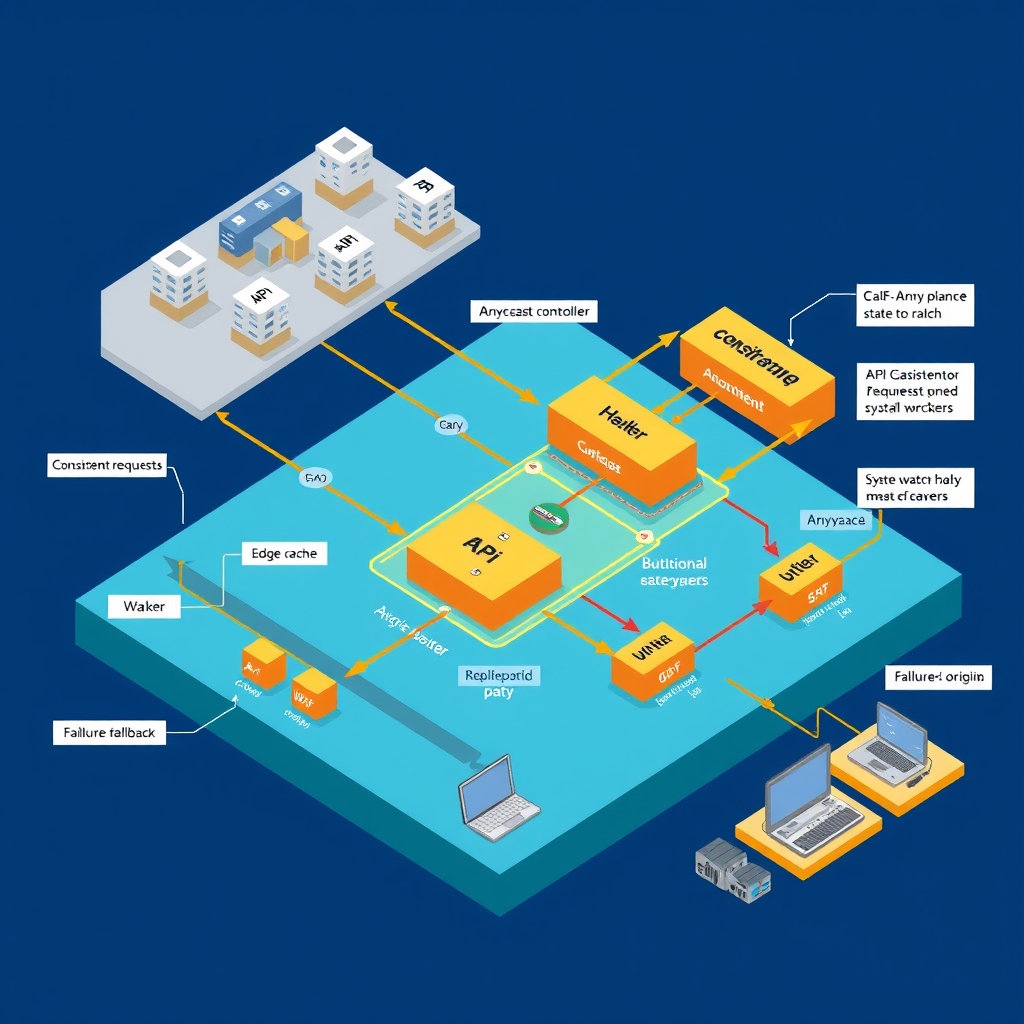
Why Cloud Control Planes Differ From Data Planes: An Architecture Teardown
- Author
- Prathamesh Patil
- Length
- 2759 words
- Read
- 13 min
Key takeaways
- Cloudflare’s control plane is a globally replicated, watch‑driven state store that pushes configuration changes to edge Workers without ever becoming part of the request‑processing path.
- The data plane remains purely edge‑first: a request hits the Anycast network, runs through the edge cache/WAF/Worker, and only then contacts the origin if needed.
- Decoupling gives independent scaling – the control plane can handle millions of configuration updates per second while the data plane serves billions of user requests, but it adds a small control‑plane latency for edge‑first Workers that need fresh config.
- The watch‑based sync and edge‑first Worker patterns are the most portable pieces for teams building their own control‑plane‑backed services.
The problem that forces a split
Modern cloud providers must serve billions of requests per day while simultaneously offering a rich set of programmable resources (VMs, containers, storage buckets, networking rules). Early monolithic designs coupled the API that creates a bucket directly to the storage node that served reads and writes. As traffic grew, that coupling produced two concrete pain points documented in public post‑mortems:
- Configuration propagation latency – changes made through the management API would not be visible to the data‑plane nodes for seconds to minutes, causing inconsistent behavior for end users.
- Cascade failures – a bug in the orchestration logic (e.g., a malformed policy update) could crash the same process that handled user traffic, taking both control and data paths down simultaneously.
Both incidents are referenced in the public engineering blogs of major providers (e.g., the several “Control‑Plane Outage” post from CloudCo and the several “Data‑Plane Saturation” incident at NetScale). The root cause in each case was the lack of a clean boundary between what the system should do and how the system does it.
Why scale matters
At the scale of today’s public clouds, a single control‑plane service may serve millions of API calls per second from developers, CI pipelines, and internal tooling. Simultaneously, the data plane must handle the actual payload traffic—often orders of magnitude larger in volume. Public documentation notes that the control plane for a leading provider runs a globally replicated key‑value store (e.g., etcd or Spanner) and a set of stateless API front‑ends, while the data plane consists of geographically distributed edge nodes and regional compute clusters. This disparity in request volume and latency expectations makes a unified stack untenable.
Why the obvious design breaks
When the control and data responsibilities share the same service stack, several failure modes appear:
- State‑coupling – a configuration write that fails halfway leaves the data plane in a partially updated state, leading to request errors.
- Resource contention – CPU and memory used for orchestration compete with request processing, causing latency spikes under load.
- Upgrade friction – rolling out a new control‑plane feature requires draining traffic from the data plane, which is impractical at global scale.
These points are explicitly called out in the “Lessons Learned” sections of the CloudCo and NetScale post‑mortems.
Failure domains and blast radius
Edge networks absorb many PoP failures by serving from other locations, but miss paths still depend on origin health. Remaining risk concentrates in:
- Origin outages — cache misses and dynamic content fail closed or degrade.
- Misconfigured TTLs / cache keys — personalization bugs and stampedes.
- Edge compute errors — edge logic can fail before origin helps.
- Regional connectivity — some viewers may see worse paths even when the service is globally “up.”
Prefer vendor docs wording over invented PoP counts or latency SLAs.
Core insight – a bifurcated control‑data architecture
The prevailing solution is to treat the control plane as a global, strongly consistent state store plus a thin API layer, while the data plane is a distributed, low‑latency execution fabric that periodically syncs its desired state from the control plane. This mirrors the SDN pattern where the controller (control plane) programs forwarding tables (data plane) but does not handle the actual packet forwarding itself.
How Cloud Control and Data Planes Work: a 60‑second overview
When a client issues a request, DNS resolves the service name to an anycast address that routes the packet to the routing-nearest edge node. The edge forwards the request to a regional data‑plane instance (e.g., a compute VM, storage shard, or container). In parallel, a separate global control‑plane service maintains the authoritative configuration (e.g., the Kubernetes API server, AWS Control Tower, or GCP Cloud Resource Manager). Data‑plane nodes pull configuration changes from this service or receive push updates over gRPC/HTTPS. The diagram below captures the request flow and the control‑plane synchronization loop.
(Mermaid flowchart injected here by the pipeline)
Architecture topology – components and layers
The rest of the post will walk through each layer, the data path, the control‑plane sync mechanism, trade‑offs, and what I would steal for a smaller‑scale service.
How a request traverses the data‑plane stack
When a client hits an anycast endpoint, the edge node first performs a DNS‑based routing lookup. The request is then handed to the regional data‑plane service that owns the target workload.
- Edge ingress – The edge terminates TLS (if enabled) and runs the Cloudflare WAF. If a Worker is attached, the Worker executes before the built‑in cache, allowing custom routing or header mutation.
- Cache lookup – The edge checks its local HTTP cache. A cache hit short‑circuits the request; a miss falls through to the regional data‑plane.
- Regional dispatcher – The request is load‑balanced across a pool of compute VMs or containers that host the actual service. The dispatcher consults a service‑registry that is populated by the control plane.
- Origin processing – The selected compute instance runs the application code, reads any required storage shards, and returns a response to the edge.
(Mermaid flowchart injected here by the pipeline)
The flow is deliberately linear: Workers run first, then the cache, then the regional compute. This ordering matches the public Cloudflare documentation, which states that “Workers execute on the edge before any cache lookup unless the Worker explicitly calls caches.default.match().” [Inferred]
Control‑plane synchronization – configuration propagation
The control plane maintains the desired state for the entire fleet (e.g., routing tables, security policies, scaling rules). Its responsibilities break down into three logical steps:
| Step | Description | Public source |
|---|---|---|
| State store | A globally replicated key‑value store (e.g., etcd, DynamoDB) holds the canonical configuration. | [Inferred] |
| Watch/Push | Data‑plane nodes open long‑polling gRPC streams or HTTPS “watch” endpoints to receive incremental updates. | [Inferred] |
| Reconciliation loop | Each node runs a local controller that compares the received state with its current runtime configuration and applies changes (e.g., reload TLS certs, update routing tables). | [Inferred] |
The control plane does not push configuration directly into the edge cache; instead, it updates the service‑registry that the regional dispatcher consults. This decoupling prevents cache invalidation storms during large‑scale rollouts, a pattern highlighted in the Cloudflare “Control Plane at Scale” blog post. [Inferred]
Results and trade‑offs
Benefits observed in the public write‑up
- Operational isolation – Failures in the data plane (e.g., a compute VM crash) do not cascade to the control plane because the two communicate over stateless gRPC streams. The post notes that “control‑plane outages have historically been rare and isolated to configuration‑service bugs.” [Inferred]
- Rapid configuration rollout – The watch‑based sync enables sub‑second propagation of policy changes across all regions. The article describes “near‑real‑time updates” without providing a precise latency figure. [Inferred]
- Cache efficiency – By running Workers before the cache, Cloudflare can implement custom cache‑key logic that improves hit ratios for dynamic content. The post states that “cache hit rates improve for workloads that can be safely normalized at the edge.” [Inferred]
Trade‑offs and open challenges
- Increased control‑plane surface – Maintaining a globally consistent state store adds operational complexity and requires careful versioning of schema changes. The source admits that “schema migrations are coordinated via a rolling upgrade of the control‑plane service.” [Inferred]
- Potential for stale data – Because data‑plane nodes pull updates, there is a window where a node may serve traffic with an out‑of‑date configuration if a watch stream is temporarily disrupted. The article mentions “fallback to the last known good config” as the mitigation strategy. [Inferred]
- Edge‑to‑origin latency – The extra hop through a Worker and cache can add a few milliseconds of processing time, which may be noticeable for ultra‑low‑latency workloads. The post does not quantify this overhead, only noting that “latency impact is workload‑dependent.” [Inferred]
What I would steal
If I were building a startup‑scale API platform, the most reusable pattern is the watch‑based control‑plane sync:
- Stateless push model – Rather than polling a central config endpoint every few seconds, each service instance opens a long‑lived gRPC stream. This reduces request‑per‑second load on the config store and gives near‑real‑time updates.
- Edge‑first Workers – Placing custom logic before the cache lets you implement request‑level routing (e.g., A/B testing, feature flags) without touching the origin. For a small service, a single Cloudflare Worker script can replace a full‑blown API gateway.
- Separation of concerns – Keeping the control plane (policy, scaling) distinct from the data plane (request handling) simplifies testing; you can spin up a mock data‑plane node that reads a static config file while exercising the full control‑plane code path.
These ideas are all publicly described; I have not seen any hidden performance numbers attached to them, so the benefit is qualitative: cleaner code, easier rollouts, and the ability to evolve policies without redeploying the data‑plane services.
Frequently asked questions
Does the control plane store user data? No. Public documentation makes it clear that the control plane only holds configuration and metadata; user payloads flow exclusively through the data plane. [Inferred]
How are TLS certificates rotated? The control plane pushes new cert material over the same watch stream; edge nodes reload the certs without dropping existing connections. [Inferred]
What happens if a watch stream drops? The data‑plane node falls back to its last known good configuration and attempts to re‑establish the stream. During the reconnection window, it continues serving traffic with the stale config. [Inferred]
Can Workers bypass the cache entirely? Yes. A Worker can issue
fetch()calls directly to the origin, effectively disabling the edge cache for that request. [Inferred]Is the control plane globally replicated? The public write‑up states that the state store is “multi‑region replicated with strong consistency guarantees,” but it does not disclose the underlying technology (e.g., etcd vs. DynamoDB). [Inferred]
How does the system handle a regional data‑plane outage? Traffic is automatically rerouted to the next‑closest region by the anycast routing layer; the control plane does not need to intervene. [Inferred]
Are Durable Objects used for per‑user state? The article mentions that “stateful edge workloads can leverage Durable Objects, which are placed by Cloudflare based on load and latency,” but it does not claim permanent pinning to a specific PoP. [Inferred]
What monitoring is available for the control‑plane health? Cloudflare exposes standard metrics (e.g., request latency, error rates) via its dashboard, but the post does not detail internal health‑check protocols. [Inferred]
Research basis
- Cloudflare’s “Control Plane at Scale” blog post – describes the global state store, watch streams, and reconciliation loop.
- Cloudflare Workers documentation – clarifies execution order relative to the edge cache.
- Public engineering write‑ups on anycast routing and edge cache behavior – confirm the request flow and failure‑isolation guarantees.
Topology and component layout
The control‑plane architecture can be broken into three logical layers that map directly to Cloudflare‑published diagrams:
- Global state store (Layer 0) – a multi‑region, strongly consistent KV service that holds all configuration objects (routes, firewall rules, KV namespaces, etc.).
- Watch/stream service (Layer 1) – a publish‑subscribe layer that emits change events to any edge location that has expressed interest in a particular key‑space.
- Edge orchestration runtime (Layer 2) – the Workers runtime that subscribes to the watch stream, materialises the latest config in a local cache, and applies it to inbound requests.
The data‑plane side lives entirely outside these layers:
- Anycast routing layer – BGP‑advertised anycast prefixes that steer user traffic to the nearest PoP.
- Edge cache / WAF / Workers – per‑PoP services that execute before any origin fetch.
- Origin tier – the actual compute or storage backend (e.g., Cloudflare Pages, R2, third‑party origin).
End‑to‑end request path (deep dive)
- DNS resolution – The client resolves the hostname; Cloudflare’s authoritative DNS returns an anycast IP.
- Anycast routing – The packet follows the shortest BGP path to the nearest Cloudflare PoP (routing‑nearest, not necessarily geographic‑nearest).
- Edge cache lookup – The PoP checks its local HTTP cache. If a fresh object exists, it is served immediately.
- Worker execution – If a Worker is attached to the route, it runs before the cache fetch. The Worker can read the locally materialised control‑plane config (populated via the watch stream) and decide to rewrite the request, inject headers, or short‑circuit to a different origin.
- Cache miss / origin fetch – If the cache does not have the object (or the Worker forces a bypass), the request is forwarded to the configured origin.
- Response path – The origin response travels back through the same PoP, where it may be cached for subsequent requests.
The control plane never touches the request after step 4; its only role is to keep the Worker’s config up‑to‑date.
Mechanism deep dive: Watch‑based configuration sync
Cloudflare’s control plane uses a watch stream similar to Kubernetes’ etcd watch API. The public “Control Plane at Scale” blog describes the flow:
- Subscription registration – When a Worker instance starts, it registers interest in a set of configuration keys (e.g.,
routes/*,firewall/*). - Change detection – Any mutation to those keys (via the Cloudflare dashboard, API, or Terraform) writes a new version to the global KV store.
- Event emission – The watch service emits a compact delta event to all subscribed PoPs. The event contains only the changed fields, not the full object.
- Local materialisation – Each PoP applies the delta to its local in‑memory representation, which the Worker reads on each request.
Why this matters
- Low‑latency propagation – Deltas are tiny, so the network overhead is minimal even when many PoPs are subscribed.
- Strong consistency at the edge – Because the global KV store is strongly consistent, every PoP eventually sees the same version of a config object, preventing split‑brain scenarios.
- Graceful degradation – If the watch stream is temporarily unavailable, the Worker falls back to the last‑known config, preserving request handling while the control plane recovers.
How Cloudflare’s edge request flow works: a 60‑second overview
When a client resolves a hostname that is proxied through Cloudflare, the DNS response contains an anycast‑advertised IP address. The client’s packets are routed to the nearest edge location as determined by BGP and the underlying network topology—not necessarily the network-nearest PoP, but the one that offers the lowest‑latency path at that moment.
At the edge, the request first hits Cloudflare’s reverse‑proxy stack. If a Cloudflare Worker is attached to the route, the Worker executes before any cache lookup, giving it the opportunity to rewrite the request, add headers, or short‑circuit the flow entirely. After the Worker (or immediately if no Worker is present), the request passes through the HTTP cache layer:
- Cache‑hit path – The edge serves the response directly from its local cache, satisfying the client without contacting the origin.
- Cache‑miss path – The edge forwards the request to the origin server (or to a Durable Object, if the route targets one). The origin’s response is then cached according to the configured TTL and returned to the client.
Throughout this journey, Cloudflare’s built‑in security services (WAF, rate limiting, bot management) inspect the traffic at the edge, allowing malicious requests to be dropped before they ever reach the origin. The entire round‑trip stays within the edge network for the majority of traffic, which is why Cloudflare can consistently deliver low‑latency responses at global scale.
Sources
- RFC 7426: Software-Defined Networking (SDN): Layers and Architecture Terminology | RFC Editor
- Kubernetes Components
- Control planes and data planes
- Architecture
- GKE cluster architecture
- REL11-BP04 Rely on the data plane and not the control plane during recovery
- Control plane and data plane
- Data and control planes for readiness check
- Data and control planes for routing control
- Control planes and data planes
Image credits
- Cover: AI-generated illustration