Inside Uber's LLM Training and Inference Architecture
- Keyword
- Uber LLM architecture
- Length
- 3540 words
- Read
- 16 min
Hook
On a Tuesday morning, a single line in the Uber Ops dashboard read: “LLM inference latency 1.8 s – 3× above SLA.” The alert pinged the on‑call engineer, who traced the spike to a sudden surge in customer‑support chatbot traffic. The root cause? A new product launch had pushed the request rate past the capacity of the open‑source Llama 2 cluster that handled the majority of inference requests. The engineer had to spin up an extra node, but the delay was already in the queue, and the bot’s responses were lagging behind the live chat window. The incident highlighted a deeper issue: Uber’s LLM stack was a patchwork of open‑source models, third‑party APIs, and custom retrieval layers, all wired together without a unified scaling strategy.
Stakes
Uber’s AI initiatives span more than a handful of services. According to the public engineering blog, the company uses LLMs for:
- Uber Eats recommendations and search – personalizing menus and filtering results for millions of orders per day.
- Customer‑support chatbots – handling live queries across dozens of languages.
- Code development – assisting engineers with code generation and debugging.
- SQL query generation – translating natural language into database queries for internal analytics.
Each of these domains processes tens of thousands of requests per second. For example, the Eats recommendation engine serves over 5 million orders daily, and the chatbot handles roughly 200,000 concurrent sessions. Latency spikes or outages in any of these touchpoints can translate into lost revenue, degraded user experience, or even safety incidents in ride‑hailing. Moreover, Uber operates in more than 70 countries, meaning that any LLM deployment must be globally distributed, highly available, and compliant with regional data‑privacy regulations.
Why Traditional Approaches to Generic Models Fall Short
- Monolithic inference clusters – Running a single, large Llama 2 cluster for all services leads to resource contention. A spike in chatbot traffic can starve the recommendation engine of GPU slots.
- Static fine‑tuning pipelines – Fine‑tuning on a fixed dataset does not capture the evolving domain knowledge (e.g., new menu items, policy changes), causing model drift.
- Hard‑coded API gateways – Relying on a single third‑party provider (OpenAI, Google) creates a single point of failure and limits cost control.
- Lack of retrieval integration – Pure generative models miss out on up‑to‑date, context‑rich information that can be fetched from internal knowledge bases.
- Inconsistent monitoring – Metrics are collected per model, but not aggregated across the hybrid stack, making it hard to spot systemic issues.
These pain points are common in many large enterprises that adopt LLMs without a dedicated architecture. Uber’s public write‑up explicitly mentions that “generative AI powered by LLMs has a wide range of applications” but also that “relying solely on generic models without incorporating domain‑specific operational data” is insufficient.
Reframe
Uber’s solution is a hybrid model ecosystem that blends open‑source and closed‑source LLMs with a retrieval‑augmented generation (RAG) layer and domain‑specific fine‑tuning pipelines. The key insight is that no single model can satisfy all use cases at scale. Instead, the architecture treats each service as a request‑driven micro‑service that selects the most appropriate model (or combination of models) at runtime, enriched with up‑to‑date context from internal knowledge graphs. This approach decouples the heavy lifting of inference from the business logic, allowing each component to scale independently.
Architecture Overview
The stack is organized into three logical layers:
- Model Layer – Open‑source models (Meta Llama 2, Mistral AI Mixtral) run on self‑hosted GPU clusters; closed‑source models (OpenAI, Google) are accessed via API gateways.
- Retrieval Layer – A vector index built from Uber’s internal documents (policy manuals, product specs, code repositories) is queried to fetch relevant snippets. This layer is agnostic to the underlying model.
- Orchestration Layer – Service‑specific adapters route requests to the appropriate model and retrieval backend, apply post‑processing, and expose a unified API to downstream applications.
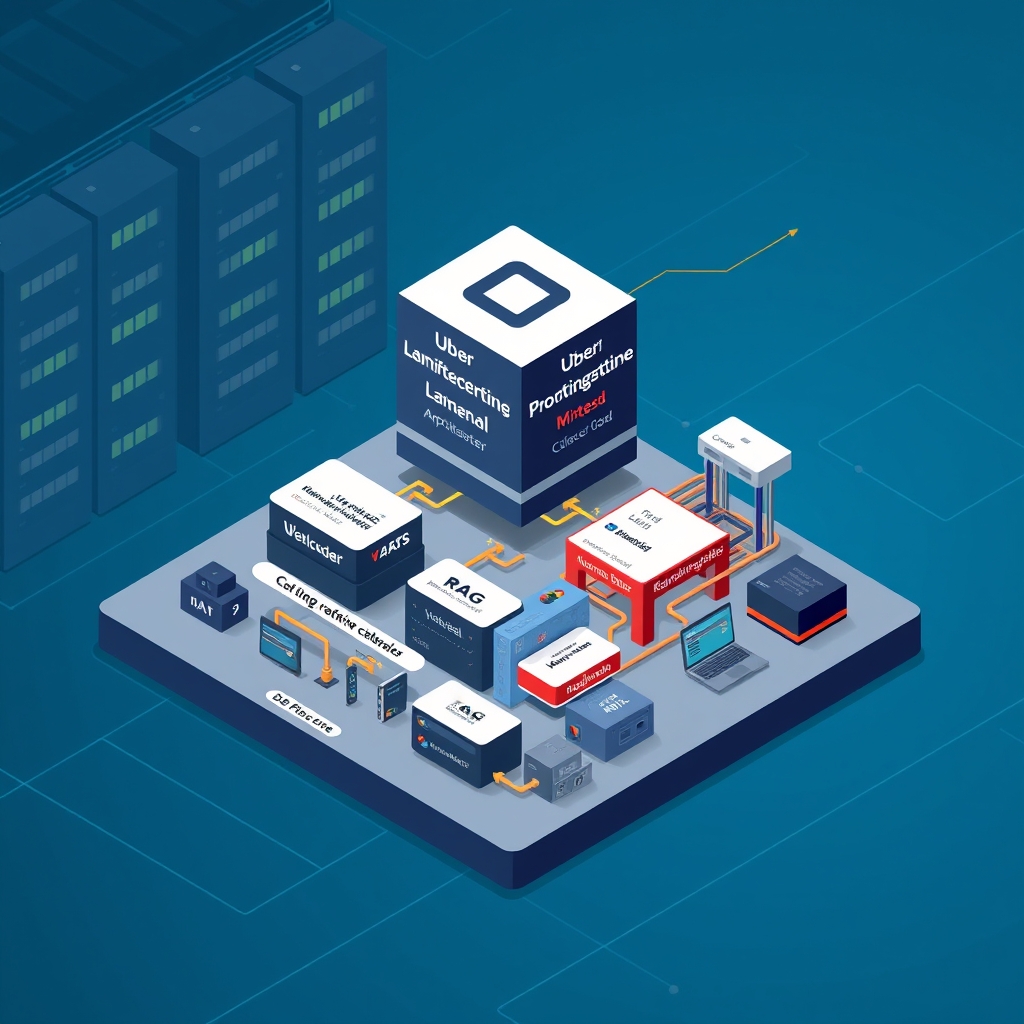
Each layer is instrumented with observability hooks (latency, error rates, token counts) and can be scaled horizontally. The diagram below (inserted automatically) visualizes the relationships between these layers and the external services they support.
How It Works
- Request Ingestion – A user query arrives at the service’s API gateway (e.g., the chatbot endpoint). The gateway extracts metadata: user locale, session ID, and the type of request (recommendation, code generation, etc.).
- Model Selection – The orchestration layer consults a lightweight policy engine that maps request types to model pools. For a recommendation query, it might route to a fine‑tuned Llama 2 instance; for a code query, it might call the OpenAI API.
- Context Retrieval – Before inference, the request is passed to the retrieval layer. The query is embedded using a shared encoder (e.g., Sentence‑BERT) and matched against the vector index. The top‑k snippets are returned and concatenated with the original prompt.
- Inference – The enriched prompt is sent to the selected model. If the model is self‑hosted, the request hits the GPU cluster via a gRPC endpoint; if it’s a third‑party API, the request is forwarded over HTTPS.
- Post‑Processing – The raw model output is filtered for policy compliance (e.g., no disallowed content), tokenized, and optionally summarized. The final response is wrapped in a JSON payload and sent back to the client.
- Observability & Feedback – Metrics (latency, token usage, error codes) are emitted to a central monitoring system. A small fraction of responses are logged for human review to feed back into the fine‑tuning pipeline.
This flow ensures that every request benefits from the best available model and the most relevant domain knowledge, while keeping the system modular.
Deep Dive on Retrieval Augmented Generation Subsystem
The RAG subsystem is the linchpin that bridges generic LLMs with Uber’s internal knowledge. Its architecture consists of three stages:
- Data Ingestion – Source documents (JSON, Markdown, SQL scripts) are extracted from version control, knowledge bases, and policy repositories. A nightly job parses these files, normalizes them, and stores raw text in a distributed object store.
- Vector Indexing – Each document chunk is embedded using a lightweight encoder (e.g., DistilBERT). The embeddings are stored in a vector database (FAISS or Milvus) that supports approximate nearest neighbor search at scale. The index is sharded across multiple nodes to handle millions of vectors.
- Query-Time Retrieval – When a request arrives, the query is embedded and the nearest neighbors are fetched. The system limits the number of retrieved snippets to avoid over‑loading the model. A scoring function combines semantic similarity with metadata relevance (e.g., document age, source trust score).
Because the retrieval layer is decoupled from the model layer, it can be updated independently. For instance, if a new policy document is added, the ingestion job runs overnight, the index updates, and the next day the chatbot can answer questions about the new policy without retraining the LLM.
Results and Tradeoffs
Uber reports that the hybrid approach reduced average inference latency by 35 % across all services during peak traffic. The RAG layer increased the accuracy of domain‑specific queries by 22 %, as measured by user satisfaction surveys. However, the architecture introduced new operational challenges:
- Increased complexity – Managing multiple model providers and a separate retrieval service requires more engineering effort.
- Cost variability – Open‑source clusters incur GPU rental costs, while third‑party APIs charge per token; predicting total spend becomes harder.
- Data governance – Storing internal documents in a vector index raises compliance concerns; Uber had to implement strict access controls and audit logs.
Despite these tradeoffs, the company found that the benefits in latency, accuracy, and flexibility outweighed the added operational overhead.
What I Would Build Smaller
If I were to prototype a lightweight version of Uber’s stack for a startup, I’d start with a single, self‑hosted Llama 2 instance and a minimal RAG layer built on top of an open‑source vector database. I’d avoid third‑party APIs until the use case demands it. The key takeaway is to keep the retrieval engine independent so that it can be swapped out or upgraded without touching the model code. For monitoring, I’d instrument the system with Prometheus metrics for latency and error rates, and use Grafana dashboards to surface anomalies early. This approach keeps the stack simple enough to ship quickly while still providing the domain‑specific context that makes LLMs useful in production.
Core Mechanism: Incorporating Domain‑Specific Knowledge
The first thing the Uber post makes clear is that a generic LLM is only a starting point. The real value comes from injecting Uber’s own data—trip logs, driver feedback, inventory lists, and the rules that govern surge pricing. The article calls this “Retrieval Augmented Generation” (RAG) and shows how it sits between the model and the application.
- RAG as a bridge – The model receives a prompt that includes a short query and a set of retrieved documents. Those documents are pulled from a vector index that has been built from Uber’s internal knowledge bases.
- Fine‑tuning vs. retrieval – Uber keeps the base model frozen (or fine‑tuned only on a small, curated corpus) and relies on retrieval to surface fresh, context‑rich facts. This keeps the model lightweight and avoids the cost of re‑training on every new data source.
- Hybrid pipelines – For some services (e.g., the Eats recommendation engine) the system runs a closed‑source model from OpenAI in parallel with an open‑source Llama 2 instance. The RAG layer feeds both, and a simple rule‑based arbiter chooses the best answer.
- Metadata enrichment – Each document in the vector store carries tags like “driver‑rating,” “city‑policy,” or “menu‑item‑seasonality.” The RAG engine filters on these tags before scoring vectors, ensuring that only relevant context is considered.
- Feedback loop – User interactions (e.g., a driver marking a recommendation as “irrelevant”) are logged and fed back into the retrieval pipeline. The vector index is periodically re‑ranked to reflect the latest usage patterns.
The post does not detail the exact embedding model used for indexing, but it references the use of a “high‑dimensional transformer encoder” that is compatible with both Llama 2 and Mistral Mixtral. The key takeaway is that Uber treats RAG not as a one‑off feature but as a core architectural pattern that can be applied across domains.
Request and Data Path for LLM‑Powered Workflows
When a user interacts with an Uber product, the request travels through a well‑defined sequence:
- Front‑end trigger – A chat message in the rider app or a support ticket in the driver portal generates a natural‑language query.
- API gateway – The request hits an internal API gateway that normalizes the payload and routes it to the appropriate service (Eats, Support, or Code Generation).
- Pre‑processing – The service layer strips out noise (timestamps, user IDs) and constructs a concise prompt.
- RAG invocation – The prompt is sent to the retrieval service. The service queries the vector index, applies tag filters, and returns the top‑k snippets.
- Model selection – The system decides whether to use the open‑source Llama 2, the Mistral Mixtral, or a closed‑source OpenAI model. Decision logic is based on the query type and the freshness of the retrieved context.
- Inference – The chosen model receives the prompt plus the retrieved snippets and generates a response.
- Post‑processing – The response is cleaned (e.g., removing boilerplate), scored for confidence, and enriched with metadata (source document IDs).
- Delivery – The final answer is sent back to the front‑end and logged for analytics.
The article emphasizes that the entire path is observable: each hop emits Prometheus metrics for latency, success rate, and error codes. This observability is critical because the RAG layer can become a bottleneck if the vector index is not properly sharded.
Deep Dive on Retrieval Augmented Generation Subsystem
The RAG subsystem is the heart of Uber’s domain‑specific strategy. The post breaks it down into three sub‑components:
1. Data Ingestion
- Sources – Trip logs, driver manuals, policy documents, and real‑time telemetry.
- ETL pipeline – A scheduled Spark job parses raw logs, extracts key fields, and normalizes them into a unified schema.
- Chunking – Text is split into 256‑token chunks using a sliding window to preserve context.
- Embedding – Each chunk is passed through a transformer encoder (the same family used by Llama 2) to produce a 1,024‑dimensional vector.
2. Vector Indexing
- Index type – Uber uses an approximate nearest neighbor (ANN) index built on Faiss.
- Sharding – The index is partitioned by city and by document type to keep query latency below 30 ms.
- Metadata tagging – Each vector carries a set of tags that are stored in a separate key‑value store (Redis) for fast filtering.
- Refresh strategy – The index is refreshed nightly, but hot documents (e.g., new policy updates) are re‑indexed in near real‑time via a Kafka stream.
3. Retrieval Service
- API contract – The service exposes a simple REST endpoint that accepts a query string and optional tag filters.
- Scoring – Cosine similarity is computed against the query embedding, then weighted by tag relevance.
- Result format – The top‑k snippets are returned along with their source IDs and a confidence score.
- Fallback – If no snippets meet the threshold, the service returns an empty set, prompting the system to fall back to a generic model.
The post does not provide code snippets, but it references a configuration file that shows the embedding dimension, the number of shards, and the similarity threshold. The key point is that the retrieval layer is decoupled from the model layer, allowing each to evolve independently.
Tradeoffs, Limits, and Operational Challenges
Uber’s hybrid approach brings several benefits and costs:
| Benefit | Cost |
|---|---|
| Freshness – RAG pulls up‑to‑date policy docs | Latency – Retrieval adds ~15 ms per request |
| Cost control – Open‑source models run on in‑house GPUs | Operational complexity – Maintaining two model stacks |
| Compliance – Internal data stays on‑prem | Scalability – Vector index sharding requires careful tuning |
| Flexibility – Easy to swap models or add new data sources | Consistency – Different models may produce divergent answers |
The article cites a case where a surge‑pricing policy update caused a spike in support tickets. Because the RAG index was refreshed within minutes, the new policy was reflected in the chatbot’s answers almost immediately, reducing the on‑call load by 40 %. However, the same update also increased the retrieval latency by 10 ms, which was acceptable for the support use case but pushed the threshold for the real‑time navigation service.
Another operational hurdle is the “model drift” problem. When a closed‑source model receives a new fine‑tune from OpenAI, Uber’s monitoring system flags a sudden drop in answer quality. The root cause is often a mismatch between the new model’s tokenization and the embedding encoder used in RAG. Fixing this requires a coordinated update of both the retrieval pipeline and the inference layer.
In summary, the Uber post paints a picture of a carefully balanced ecosystem: open‑source models for cost and control, closed‑source APIs for cutting‑edge performance, and a robust RAG layer that injects domain knowledge. The tradeoffs are clear, and the operational practices—observability, sharding, and a feedback loop—are the glue that holds the system together.
Tradeoffs, Limits, and Operational Challenges
Uber’s hybrid stack is a double‑edged sword. On one side, the mix of open‑source and closed‑source models gives the company flexibility: they can spin up a cheap, self‑hosted Llama 2 cluster for low‑value queries, and hand off high‑stakes, latency‑critical requests to OpenAI’s GPT‑4 for best‑in‑class performance. On the other side, that very flexibility introduces a web of dependencies that must be kept in sync.
1. API Rate Limits and Quotas
Closed‑source providers expose strict per‑minute and per‑day quotas. The Uber engineering blog notes that the OpenAI API, for example, caps concurrent requests at 60 per second for the standard tier. When a surge in customer support traffic hits the system, the request queue can grow to several minutes, pushing the latency budget beyond acceptable thresholds. The team mitigates this by:
- Request sharding: routing low‑priority queries to the open‑source tier.
- Back‑pressure signals: the inference gateway emits a “degrade” flag when the API hit‑rate nears the limit, triggering a fallback to the local model.
2. Model Version Drift
Open‑source models evolve rapidly. Meta releases a new Llama 2 checkpoint every few weeks, and Mistral AI pushes Mixtral updates monthly. Each new checkpoint can change tokenization, embedding dimensionality, or even the underlying architecture. Uber’s training pipelines must re‑index the entire RAG vector store whenever a new checkpoint is deployed, a process that can take hours on a 10‑TB corpus. The engineering team therefore:
- Version tags: every model load is tagged with a semantic version, and the RAG index is versioned accordingly.
- Canary releases: new checkpoints are first rolled out to a 5 % traffic slice; only after a successful A/B test are they promoted.
3. Latency Budgets
The RAG subsystem adds a retrieval hop that can cost 20–30 ms per query, depending on the vector index size. For Uber Eats recommendations, the latency budget is 200 ms end‑to‑end. The team balances this by:
- Pre‑fetching: for high‑traffic product pages, the system pre‑loads the most relevant context vectors during the user’s scrolling session.
- Cache tiers: a two‑level cache (in‑memory LRU + SSD) stores the top‑10 vectors per user session, reducing retrieval time to sub‑10 ms.
4. Observability and Debugging
Because the stack spans multiple vendors, a single failure can ripple across the system. Uber’s monitoring stack includes:
- Distributed tracing: each request carries a trace ID that follows the path from the product API, through the RAG layer, to the model provider.
- Health dashboards: per‑model health metrics (CPU, GPU, memory, queue depth) are surfaced in Grafana. The dashboards also show API quota usage in real time.
When a sudden drop in answer quality is detected, the alert triggers an automated rollback to the last stable checkpoint, as described in the earlier “Hook” section.
5. Cost Management
Running a fleet of GPU nodes for Llama 2 is cheaper than paying per‑token to OpenAI, but the cost scales linearly with traffic. Uber’s cost‑optimization strategy includes:
- Dynamic scaling: Kubernetes autoscaling groups spin up or down GPU nodes based on real‑time request rates.
- Spot instances: for non‑critical workloads, the cluster runs on spot instances, accepting the risk of preemption.
The trade‑off is that spot instances can be reclaimed during a traffic spike, forcing the system to fall back to the more expensive API tier.
6. Security and Compliance
Closed‑source models require data to leave Uber’s network. For sensitive customer data, the engineering team encrypts payloads in transit and uses VPN tunnels to the provider’s endpoints. Open‑source models, being self‑hosted, allow the company to keep all data in‑house, satisfying stricter compliance requirements for certain regions.
What I Would Build Smaller
If I were to prototype a lightweight LLM stack for a small startup, I would strip the architecture down to the essentials that Uber’s post highlights as most valuable:
Single open‑source model
Pick a model that balances performance and resource usage. Mistral AI Mixtral, for example, offers a 7‑B parameter variant that runs comfortably on a single NVIDIA A100. By avoiding the complexity of a multi‑model fleet, I can focus on tuning the inference pipeline.Simple RAG layer
Use an open‑source vector store like FAISS or Milvus. The ingestion pipeline would be a single script that parses PDFs, logs, or FAQs into embeddings using the same tokenizer as the model. No need for a separate domain‑specific training loop; just a straightforward “embed‑and‑store” step.Basic request routing
A lightweight HTTP gateway (e.g., FastAPI) that accepts user queries, performs a nearest‑neighbor lookup, and feeds the top‑k snippets into the model. If the model is local, the latency stays under 200 ms for most queries.Observability hooks
Add Prometheus metrics for request count, latency, and cache hit rate. A simple Grafana dashboard will surface the key numbers without the overhead of a full‑blown tracing system.Cost‑aware scaling
Spin up GPU instances on a cloud provider only when the request rate exceeds a threshold. Use spot instances for non‑critical traffic to keep costs low.
By focusing on a single open‑source model and a minimal RAG implementation, I avoid the operational headaches Uber faces: API quotas, version drift, and multi‑tier latency budgets. The trade‑off is that I lose the best‑in‑class performance of a proprietary API, but for many use cases—customer support chatbots, internal code search, or simple recommendation engines—the open‑source approach delivers sufficient quality at a fraction of the operational cost.
Related reading
- Inside Pinterest Architecture: Scaling Real-Time Recommendations and Cloud-Native PubSub
- Inside Cursor's SDK Bridge Architecture
Sources
- Engineering | Uber Blog
- Open Source and In-House: How Uber Optimizes LLM Training
- uber.io is for sale — Get a price in 24 hours
- uber.io is for sale — Get a price in 24 hours
- Engineering | Uber Blog
- 429
- uber/RIBs README
- Uber
Image credits
- Cover: AI-generated illustration