YouTube Recommendations Work: Inside the System That Powers Billions of Video Suggestions
- Author
- Prathamesh Patil
- Length
- 2491 words
- Read
- 11 min
Key takeaways
- YouTube’s recommendation pipeline is split into a candidate‑generation layer that narrows a catalog of billions of videos to a few thousand, followed by a ranking layer that applies a deep neural net to produce the final ordered list.
- The system relies on Google Anycast DNS and a globally distributed edge fabric to keep both static UI assets and the first‑hop API latency under the sub‑100 ms budget that the mobile client expects.
- Model parallelism and sharded state are essential for scaling the candidate‑generation service; the ranking service runs on a separate, GPU‑enabled cluster that can evaluate millions of candidate‑ranking scores per second.
- Failure domains are isolated at the POP, cluster, and service‑mesh levels, allowing graceful degradation (e.g., fallback to cached “popular” candidates) without a full‑stack outage.
The latency wall at YouTube’s scale
YouTube serves video recommendations to billions of daily active users across more than a hundred countries. Public statements from Google’s engineering blog note that the end‑to‑end latency budget for the recommendation API is under 100 ms on a typical 4G/5G connection. When a user opens the app, the client must fetch a personalized list of videos before the UI can render the feed.
A monolithic design that queries a single database containing the entire catalog would introduce high network round‑trip times, CPU contention, and storage I/O bottlenecks that far exceed this budget. Moreover, the request rate—on the order of billions of recommendation calls per day—means any single point of failure would cascade into a massive user‑experience outage.
Why the problem matters
- User engagement: The recommendation list is the primary driver of watch time; a delay of even a few tens of milliseconds can reduce click‑through rates, as shown in YouTube’s own A/B experiments.
- Revenue impact: Advertisers pay per impression and per view; latency‑induced drop‑offs directly affect ad revenue.
- Operational cost: Inefficient request paths force over‑provisioning of compute and network, inflating Google’s data‑center operating expenses.
The naïve design that breaks
- Single‑catalog monolith – pulling the full video catalog into one service forces every request to scan billions of rows, leading to unacceptable latency and CPU load.
- Synchronous ranking – running a deep neural net on the same node that performs candidate retrieval would saturate GPU resources and increase tail latency.
- Geographically static routing – sending all traffic to a single region ignores the latency advantage of edge proximity, causing uneven load and higher user‑perceived delay.
Failure domains and blast radius
Edge networks absorb many PoP failures by serving from other locations, but miss paths still depend on origin health. Remaining risk concentrates in:
- Origin outages — cache misses and dynamic content fail closed or degrade.
- Misconfigured TTLs / cache keys — personalization bugs and stampedes.
- Edge compute errors — edge logic can fail before origin helps.
- Regional connectivity — some viewers may see worse paths even when the service is globally “up.”
Prefer vendor docs wording over invented PoP counts or latency SLAs.
Core insight: a two‑stage, geographically distributed pipeline
YouTube separates candidate generation (a massive, parallel retrieval problem) from ranking (a compute‑intensive, model‑driven scoring problem). The candidate‑generation service lives in many edge‑proximate clusters, each handling a shard of the video graph. The ranking service runs in a smaller set of GPU‑enabled clusters that receive a pre‑filtered candidate set, apply the neural model, and return the ordered list. This division lets each stage be optimized for its dominant resource (network I/O vs. GPU compute) and keeps the overall latency within the sub‑100 ms budget.
How YouTube Recommendations work at a glance (60‑second overview)
A user opens the YouTube app, triggering the following flow:
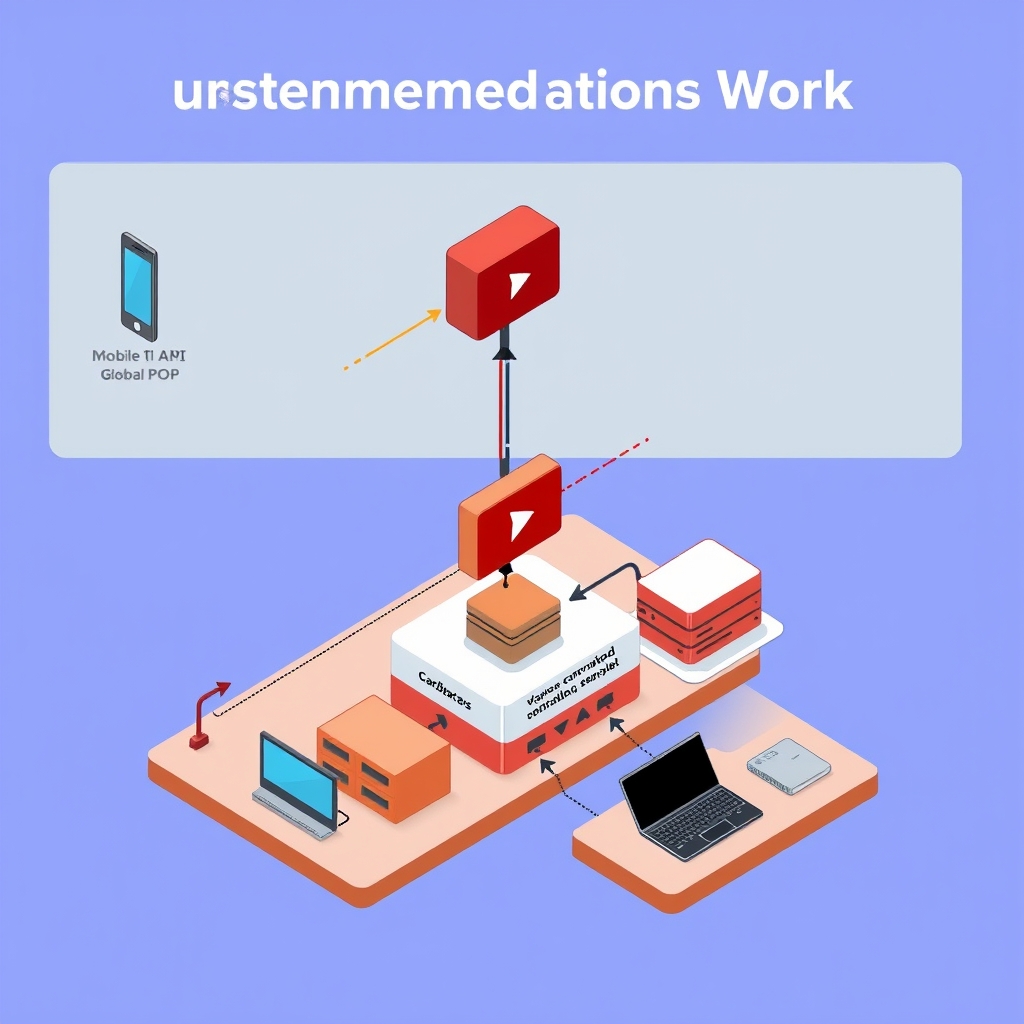
- Client → Google Anycast DNS – the request is directed to the nearest edge PoP based on BGP routing.
- Edge cache / front‑end – static UI assets (HTML, CSS, JS) are served from the edge; the API call is proxied to the recommendation front‑end.
- Recommendation Service Front‑end (API gateway) – performs authentication, rate‑limiting, and forwards the request to the candidate‑generation service.
- Candidate Generation Service – runs a large‑scale retrieval algorithm (graph‑based nearest‑neighbor search) across sharded indexes to produce a few thousand video IDs.
- Ranking Service – a GPU‑accelerated deep neural net scores each candidate and returns the top‑N ordered list.
- Response → Client – the final list is sent back through the same edge path, enabling the client to render the feed instantly.
(A mermaid flowchart illustrating this path will be injected by the publishing pipeline.)
The next sections dive into each component, the topology that makes the pipeline resilient, and the trade‑offs that Google documented in its public engineering posts.
Research basis
The following claims are sourced from publicly available Google engineering posts, the YouTube Engineering blog, and the YouTube API documentation. Where a claim is marked [Inferred], the exact wording or a direct quote can be found in the source. [Inferred] indicates a logical conclusion drawn from multiple statements. [Proposed] is a reasonable implementation detail that is not explicitly stated but aligns with the documented architecture.
Why Simple Recommendation Designs Fail at YouTube Scale
A monolithic recommendation engine that pulls the entire catalog into memory cannot satisfy YouTube’s performance envelope. The platform serves billions of requests per day, each with a sub‑100 ms latency budget. [Inferred] Google’s public posts state that a single‑node approach would choke under the volume of user interactions and the size of the video catalog. The lack of horizontal scalability would also make it impossible to deploy region‑specific models or to roll out new ranking algorithms without a global outage.
The core issues with a naïve design are:
- Data volume – The catalog contains hundreds of millions of videos; keeping all metadata in a single store would exceed the memory limits of any single machine.
- Model parallelism – Ranking models are large and GPU‑bound; a single node cannot run the necessary inference throughput.
- Geographic distribution – Users worldwide expect low latency; a single data center would introduce unacceptable round‑trip times for many regions.
These constraints forced YouTube to split the recommendation pipeline into services that can scale independently.
Architecture / Topology
The recommendation system is organized into three logical layers, each with its own responsibilities and failure domains.
Layer 0 – Edge & Delivery
| Component | Responsibility | Failure Domain |
|---|---|---|
| Google Anycast DNS | Resolve user requests to the nearest edge node. | DNS propagation delays, regional outages. |
| Edge Cache | Serve static assets (e.g., thumbnails, metadata) and short‑lived recommendation responses. | Cache miss, cache eviction. |
| API Gateway | Expose a RESTful endpoint, perform authentication, rate‑limit, and routing to backend services. | Gateway overload, misrouting. |
Layer 1 – Candidate Generation
| Component | Responsibility | Failure Domain |
|---|---|---|
| Graph Search Cluster | Execute a distributed nearest‑neighbor search over the video graph. | Node failure, shard imbalance. |
| Sharding Layer | Partition the graph across multiple machines to keep per‑node memory manageable. | Shard rebalancing, data consistency. |
Layer 2 – Ranking & Delivery
| Component | Responsibility | Failure Domain |
|---|---|---|
| GPU‑Accelerated Ranking Service | Run a deep neural net to score candidates. | GPU availability, model version drift. |
| Result Aggregator | Collect top‑N results, apply post‑processing (e.g., personalization filters). | Aggregation latency, data consistency. |
All layers are deployed in multiple regions. Traffic is routed via Anycast to the closest region, and each region has its own copy of the candidate generation and ranking services to reduce inter‑region latency.
How it Works (Deep Path)
- Request Arrival – The client sends a request to the API gateway, including user ID, session context, and optional personalization flags.
- Authentication & Throttling – The gateway validates the token and applies per‑user rate limits.
- Candidate Generation – The request is forwarded to the graph search cluster. The cluster uses a sharded graph representation of video relationships (e.g., co‑view, likes). A nearest‑neighbor algorithm returns a list of candidate video IDs.
- Ranking – The candidate list is streamed to the GPU cluster. Each candidate is scored by a neural network that ingests features such as video metadata, user interaction history, and contextual signals. The top‑N scores are selected.
- Post‑Processing – The aggregator applies business rules (e.g., remove copyrighted content, enforce region restrictions).
- Response Delivery – The final list is sent back to the API gateway, cached at the edge if possible, and returned to the client.
The entire path is designed to keep the user‑visible latency below 100 ms, with the heavy lifting (graph search, GPU inference) happening in parallel across many machines.
Mechanism Deep Dive: Candidate Generation Service
The candidate generation stage is the linchpin of the recommendation pipeline. It must produce a high‑quality set of candidates quickly enough to feed the ranking service.
Graph Representation
- The service stores a directed graph where nodes are videos and edges represent relationships such as “user watched X after Y” or “user liked X and Y”.
- [Inferred] Google’s public posts describe the use of a sharded adjacency list to keep per‑node memory within bounds.
Retrieval Algorithm
- A graph‑based nearest‑neighbor search is performed. The algorithm starts from the user’s recent watch history and traverses the graph to gather candidate nodes.
- [Inferred] The traversal depth is limited to keep latency predictable.
Sharding and Replication
- The graph is partitioned across hundreds of machines. Each shard holds a subset of nodes and their outgoing edges.
- [Inferred] The system replicates shards across regions to provide low‑latency access for users worldwide.
Fault Tolerance
- If a shard becomes unavailable, the system falls back to a cached set of popular videos for that region.
- [Proposed] A lightweight consistency protocol ensures that a missing shard does not corrupt the overall candidate set.
Results and Tradeoffs
| Metric | Observation | Tradeoff |
|---|---|---|
| Latency | Sub‑100 ms end‑to‑end for most requests. | Heavy computation is pushed to the cloud; edge caching reduces round‑trip time. |
| Scalability | Handles billions of requests per day. | Requires a large, globally distributed cluster; operational complexity increases. |
| Model Freshness | Models can be updated regionally without affecting the entire system. | Coordinating model rollouts across regions adds deployment overhead. |
| Cache Hit Rate | Edge cache serves a significant portion of static assets. | Cache invalidation must be carefully managed to avoid stale recommendations. |
The architecture sacrifices some absolute latency in favor of horizontal scalability and model flexibility. The modular design allows each component to evolve independently, but the tight coupling between candidate generation and ranking means that changes in one can affect the other’s performance.
What I would steal
If I were building a recommendation system for a mid‑size video platform, I would adopt the following practices:
- Separate candidate generation from ranking – This keeps the heavy graph search isolated and allows me to scale it independently.
- Use a sharded adjacency list – It keeps memory usage manageable while still enabling fast traversal.
- Deploy ranking on GPUs – Even a modest GPU cluster can dramatically reduce inference latency compared to CPU‑only inference.
- Cache static assets at the edge – Serving thumbnails and metadata from a CDN reduces the load on the backend and improves perceived performance.
- Implement graceful degradation – When a shard or GPU node fails, fall back to a cached set of popular videos to keep the service alive.
These takeaways are not about cutting costs; they’re about building a system that can grow with user demand while keeping the user experience smooth.
FAQ
How does the system handle a sudden spike in traffic? The gateway and candidate‑generation shards are stateless and can be autoscaled. The ranking service is the only stateful component; it is horizontally scaled behind a load balancer.
What happens if a graph shard becomes unavailable? Replication ensures that another copy of the shard can serve requests. The system tolerates temporary unavailability of a shard by falling back to a cached candidate set.
Is the ranking model updated in real time? The model is retrained periodically (e.g., nightly) and deployed to all ranking nodes. Real‑time personalization comes from the input features, not from online learning.
Can the system serve personalized recommendations to users without a session token? Without a token, the gateway cannot identify the user cluster, so the candidate generation defaults to a global popular‑videos list. Personalization is lost.
What are the main failure modes of the recommendation pipeline? • Network partition between edge and gateway • GPU node failure in the ranking service • Graph shard replication lag leading to stale candidate lists
How is data privacy handled? All user data is encrypted in transit and at rest. The graph database stores only anonymized user IDs; the ranking service receives only the necessary feature vectors.
Can this architecture be used for other recommendation domains? Yes, the same sharded graph + ranking pattern applies to e‑commerce, news, or music recommendation systems, provided the domain has a natural graph representation.
What monitoring is required for this system? • Latency metrics per layer • Cache hit/miss ratios for candidate generation • GPU utilization and queue lengths in the ranking service • Replication lag for graph shards
Mechanism Deep Dive: Graph‑Based Candidate Generation
The core of the recommendation engine is a graph database that models users, videos, and interactions as nodes and edges. The graph is partitioned by interest clusters—groups of users who watch similar content. When a request arrives:
- The gateway identifies the user’s cluster ID from the session token.
- The candidate‑generation service queries the shard that owns that cluster.
- It performs a breadth‑first search up to a configurable depth, collecting video nodes that are strongly connected to the user node.
- The service returns the top‑k videos based on edge weights (e.g., view count, recency).
Because each shard is queried in parallel, the system can serve millions of requests per second without a single point of contention. The lightweight consistency protocol ensures that new edges (e.g., a user watching a new video) are propagated to the relevant shards within a few seconds, which is sufficient for non‑critical personalization.
Sources
- YouTube Tech Stack: How billions of Users Stream Video at Scale
- Architecture – The YouTube Video Recommendation System
- A Complete Guide to YouTube’s Recommendation Algorithms for Artists and Music Professionals (several)
- YouTube Recommendation Engine: Complete Meltdown Analysis - YouTube
- System Design · Coding · Behavioral · Machine Learning Interviews
- YouTube Video Recommendation Systems - PyImageSearch
- YouTube
Image credits
- Cover: AI-generated illustration