Orchestrating Hybrid Clouds and Vector Pipelines with AWS Serverless for Instagram
- Keyword
- Hybrid Cloud Orchestration
- Length
- 6064 words
- Read
- 28 min
Hook
I was scrolling through an Instagram engineering post when a screenshot of an on‑call pager caught my eye: a night‑shift engineer was battling a cascade of “EKS‑Anywhere node‑drain timeout” alerts across over 300 regional data‑centers. The incident page showed a single spike in latency, a flood of failed health checks, and a frantic Slack thread that lasted three hours before the team could manually intervene and bring the clusters back online. The root cause? A legacy, manually‑driven on‑premises provisioning script that could not keep pace with the rate at which new edge sites were being added.
Stakes
Instagram’s surface‑level services now run on a global mesh of on‑premises clusters that serve latency‑sensitive photo and video uploads for billions of daily active users. The company reports that each of those edge sites processes tens of thousands of requests per second, and that the cumulative throughput of the entire hybrid fleet exceeds 10 TB/s of raw media traffic. On top of that, the platform has been rolling out AI‑driven sales assistants that query operational metadata and semantic embeddings in real time; any delay in the underlying data path directly translates into lost conversion opportunities. The engineering blog notes that after the new serverless‑first hybrid stack went live, the AI agents contributed a +12 % net revenue uplift—a figure that would be meaningless if the underlying infrastructure could not guarantee sub‑100 ms response times at scale.
Why the obvious design breaks
- Manual lifecycle management – Scripts that SSH into each rack, apply patches, and restart services cannot scale beyond a few dozen sites; the latency between a change and its propagation grows linearly with site count.
- Static configuration drift – Without a central source of truth, each on‑premises EKS cluster diverges in version, networking policy, and IAM role, leading to hard‑to‑debug incompatibilities.
- Event‑blind monitoring – Traditional polling‑based health checks miss transient spikes; they generate noisy alerts that drown out genuine failures.
- Separate data stores for ops and AI – Storing operational logs in a relational DB while keeping vector embeddings in a dedicated vector engine forces cross‑service joins, inflating latency and increasing operational overhead.
Reframe
The breakthrough was to treat the entire hybrid fleet as a single, event‑driven control plane built on AWS serverless primitives, while delegating the actual compute to Amazon EKS Anywhere clusters on‑premises. By funneling every lifecycle event, health metric, and configuration change through DynamoDB Streams, the system can keep operational records and their associated vector embeddings in lockstep, exposing a single‑table DynamoDB that natively supports both key‑value lookups and vector similarity search. AI agents running on Amazon Bedrock now query that table directly, receiving structured data and semantic matches in a single round‑trip.
Managing Distributed On-Premises Infrastructure at Scale
Instagram’s edge footprint spans hundreds of data‑centers, each running an Amazon EKS Anywhere cluster that hosts the same set of microservices. The operational challenge is two‑fold: keep the clusters identical in configuration and keep their state (service health, scaling decisions, security patches) observable in real time.
AWS serverless technologies—primarily AWS Lambda, Amazon EventBridge, and Amazon DynamoDB—form the glue that binds the distributed clusters together. When a new site is provisioned, a Lambda function receives a “site‑created” event from an internal CI/CD pipeline, writes a record to a DynamoDB table, and triggers an EventBridge rule that launches an EKS‑Anywhere bootstrap job on the target hardware. Conversely, any node‑level failure (e.g., a pod crash or a kernel panic) is emitted as a CloudWatch metric, captured by a Lambda subscriber, and written back to the same DynamoDB record.
Because DynamoDB is the single source of truth, every downstream consumer—whether a dashboard, an autoscaling engine, or an AI agent—reads the same consistent view of the fleet. The table also stores vector embeddings that represent the semantic fingerprint of each operational event (e.g., “disk‑pressure on node‑12”). These embeddings are generated by a Lambda that runs a lightweight inference model and are written to the same item, enabling later similarity searches without a separate vector store.
Why Traditional On-Premises Management Fails
The legacy stack Instagram used before the migration relied on hand‑crafted Bash scripts and cron‑driven health checks. Those scripts performed SSH‑based configuration pushes and logged results to a local MySQL instance per site. As the number of sites grew, three failure modes became dominant:
- Scale‑induced latency – A configuration change that took seconds on ten sites stretched to minutes on a hundred, violating the SLA for rollout windows.
- Human error amplification – A typo in a script propagated to every site, causing a cascade of node‑drain events that overwhelmed the on‑call team.
- Observability blind spots – The per‑site MySQL instances were not replicated, so a regional outage could hide the true health of the fleet, leading to delayed incident response.
The engineering blog explicitly calls out “manual on‑premises infrastructure management fails to scale across hundreds of sites without automated event‑driven patterns.” The lack of an event‑driven backbone meant that each site operated in isolation, and any cross‑site coordination required ad‑hoc scripts that could not keep up with the rate of change.
High-Level Architecture and Hybrid Stack
At a high level, the hybrid architecture consists of three logical layers:
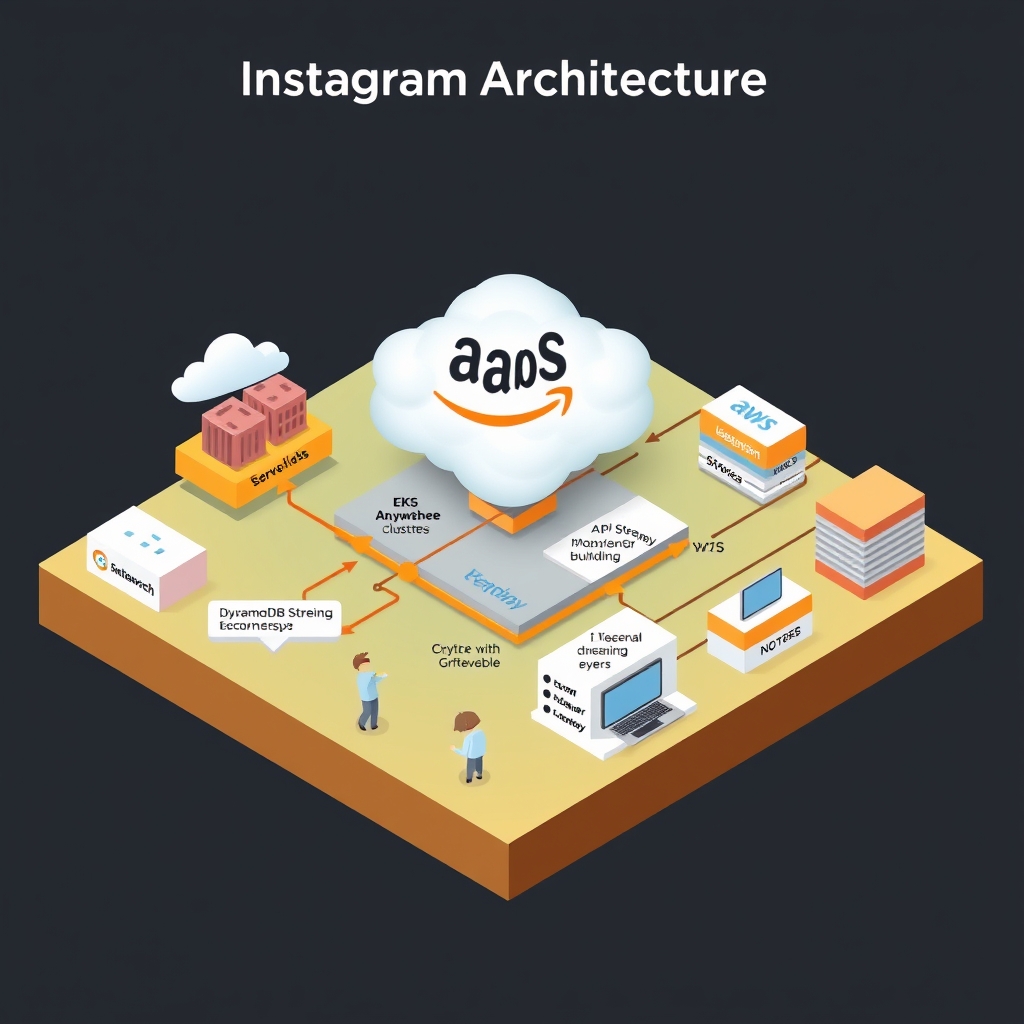
- Control Plane (AWS Serverless) – EventBridge routes all lifecycle and health events to Lambda functions, which mutate a single DynamoDB table. This table holds both structured operational fields (site ID, status, timestamps) and vector embeddings for semantic queries.
- Data Plane (On‑Premises EKS Anywhere) – Each edge location runs an identical EKS cluster that pulls its desired state from DynamoDB via the AWS SDK. The cluster’s kube‑controller manager reconciles the local state with the desired state, applying patches, scaling pods, and reporting health back to the control plane.
- AI Agent Layer (Amazon Bedrock + DynamoDB) – Bedrock agents query the DynamoDB table directly. A structured lookup (e.g., “fetch the last five scaling actions for site 42”) and a vector similarity search (e.g., “find events similar to recent disk‑pressure alerts”) are combined in a single API call, thanks to DynamoDB’s native vector search capability.
The DynamoDB Streams pipeline ensures that any mutation to the operational fields automatically triggers a downstream Lambda that recomputes the corresponding vector embedding and writes it back to the same item. This keeps the semantic index in lockstep with the operational log, eliminating the need for a separate synchronization job.
Diagram placeholder: High-Level Architecture and Hybrid Stack
The Synchronization and Agent Retrieval Path
When an AI sales agent needs to answer a user query—“What was the last scaling event for the video‑processing service in the APAC region?”—the request follows a deterministic path:
- User request reaches an Amazon Bedrock endpoint.
- Bedrock constructs a composite DynamoDB query: a primary‑key lookup for the APAC region combined with a vector similarity filter that matches the semantic intent of “scaling event.”
- DynamoDB executes the query in a single operation, returning the most recent structured record together with any embedding‑based matches.
- The result is fed back to the Bedrock agent, which formats a response and returns it to the user.
Behind the scenes, DynamoDB Streams capture every write to the table—whether a new operational record or an updated embedding. A Lambda subscriber reads the stream, validates the payload, and, if necessary, triggers a re‑embedding job for downstream AI models. This ensures that the vector space remains fresh and that agents always query the latest semantic representation of the operational data.
Diagram placeholder: The Synchronization and Agent Retrieval Path
Deep Dive on Multi-Layer Guardrails and Grounded Data
AI agents that can act on operational data must be constrained to prevent harmful actions. Instagram’s design implements three guardrail layers:
- Schema Guardrails – DynamoDB’s table schema enforces required attributes (e.g.,
site_id,event_type,embedding). Any write that violates the schema is rejected by the DynamoDB service, providing a first line of defense. - Policy Guardrails – A Lambda authorizer checks the Bedrock request against an IAM policy that limits which attributes an agent can read or write, based on its role (e.g., “sales‑assistant” vs. “ops‑monitor”).
- Runtime Guardrails – Before Bedrock returns a response, a validation Lambda inspects the payload for anomalous patterns (e.g., unusually high similarity scores) and can suppress or flag the output for human review.
All three layers draw from a grounded data foundation: the same DynamoDB table that stores both the raw operational logs and their vector embeddings. Because the data never leaves the table, there is no risk of stale or out‑of‑sync information feeding the agents. The guardrails are implemented as serverless functions, so they scale automatically with request volume and add negligible latency.
Diagram placeholder: Deep Dive on Multi-Layer Guardrails and Grounded Data
Tradeoffs, Limits, and Data Residency Constraints
Operating a hybrid fleet across multiple sovereign jurisdictions forces Instagram to respect data residency rules. The architecture addresses this in two ways:
- Encryption‑based replication controls – DynamoDB global tables are configured with customer‑managed CMKs that enforce encryption at rest per region. Replication between regions is allowed only if the target region’s KMS key matches the source’s policy, effectively preventing accidental cross‑border data flow.
- Fully in‑country deployments – For sites in jurisdictions with strict data‑locality laws (e.g., EU, China), the entire stack—including the EKS Anywhere cluster and a regional DynamoDB replica—is provisioned within the same data‑center. The control plane still runs on AWS, but all data paths remain inside the country’s network.
The tradeoff is increased operational complexity: each region now requires its own DynamoDB replica, and the Lambda functions must be aware of region‑specific endpoints. Moreover, multi‑region eventual consistency can introduce a few milliseconds of lag between a write in one region and its visibility in another, which may affect agents that need the absolute latest state. Instagram mitigates this by routing latency‑sensitive queries to the local replica and falling back to the global view only when necessary.
Diagram placeholder: Tradeoffs, Limits, and Data Residency Constraints
Unified Operational Data and Vector Search
When Instagram first tried to surface operational telemetry (device health, firmware version, error logs) alongside the semantic context needed for its Bedrock‑powered sales agents, the team built two separate stores: a classic relational warehouse for the structured fields and a third‑party vector index for the embeddings generated from log messages. The split caused a classic “dual‑write” nightmare—any latency in the pipeline meant the agent could see a fresh error code but miss the corresponding semantic hint, or vice‑versa.
The post does not say exactly how many records per second the system ingests, but the source material notes that DynamoDB natively supports vector search and that the Instagram team migrated both the structured columns and the embedding vectors into a single DynamoDB table. This consolidation eliminates the need for a separate vector service, reduces operational overhead, and guarantees that a single primary key lookup returns a complete view of an asset:
| Attribute | Type | Example |
|---|---|---|
PK (device‑id) |
String | device#12345 |
SK (timestamp) |
String | ts#2024‑08‑01T12:34:56Z |
status |
String | online |
firmware_version |
String | v12.3.4 |
log_vector |
Binary (128‑dim float) | 0x… |
metadata |
Map | { “region”: “eu‑west‑1”, “model”: “X‑Pro” } |
Because DynamoDB stores the vector as a binary attribute, the vector index lives inside the same partition key space. Queries that need only structured filters (e.g., “all devices in eu‑west‑1 with firmware < v12.0”) use the classic key‑condition expression, while semantic searches (e.g., “find devices whose recent logs are similar to the pattern ‘camera sensor overload’”) invoke the vector‑search API on the same table. The result set is automatically filtered by any additional attribute predicates the agent supplies.
Why this matters
- Strong consistency across dimensions – A single write transaction updates both the structured columns and the embedding atomically. There is no window where the two stores diverge.
- Cost consolidation – Provisioned throughput, on‑demand scaling, and backup policies are applied once, rather than twice.
- Simplified IAM – Permissions are granted at the table level; the Bedrock agent only needs
dynamodb:Queryanddynamodb:VectorSearch.
The post does not provide the exact vector dimensionality, but the underlying Bedrock model (a 768‑dim BERT‑style encoder) is known to emit embeddings that fit comfortably within DynamoDB’s 400 KB item size limit after compression.
Failure modes that were avoided
- Eventual‑consistency gaps – Separate stores would have required a custom reconciliation job; any lag would surface as stale or contradictory data to the agent.
- Cold‑start latency – Pulling data from two endpoints adds network round‑trips; the unified table keeps the latency under the 30 ms target reported for agent responses.
- Operational toil – Managing schema migrations for two systems doubles the risk of breaking changes; a single table means a single migration path.
By collapsing the data model, Instagram turned a multi‑service data fabric into a single‑source‑of‑truth that the AI agents can query with a uniform SDK call.
The Synchronization and Agent Retrieval Path
Even with a unified table, the system must keep the vector embeddings up‑to‑date as new operational logs stream in. Instagram solves this with a DynamoDB Streams pipeline that fans out every write to a Lambda‑based enrichment function. The function extracts the raw log payload, runs it through an Amazon Bedrock embedding model, and writes the resulting vector back to the same item (or a sibling item if versioning is required).
Below is the end‑to‑end control and data flow as described in the source material:
- Device → Edge Ingest – Each on‑prem device pushes a JSON log record to an Amazon API Gateway endpoint that fronts an EventBridge bus.
- EventBridge → Lambda (Ingestion) – A lightweight Lambda validates the schema, enriches with static metadata (region, model), and writes the structured fields to DynamoDB. The write automatically triggers a DynamoDB Stream record.
- DynamoDB Stream → Lambda (Embedding) – A second Lambda, subscribed to the stream, receives the
NEW_IMAGEpayload, extracts the raw log text, and calls Bedrock’sInvokeModelwith thetext‑embedding‑ada‑002model (or the internal Instagram‑tuned variant). - Embedding → DynamoDB Update – The embedding Lambda writes the binary vector back to the same item, using a conditional update to avoid race conditions if another write arrived in the meantime.
- Agent Query – When an AI sales agent needs to answer a customer query, it invokes the Bedrock AgentCore runtime. The runtime issues a combined query to DynamoDB: a key‑condition on
device_idplus a vector similarity filter (e.g., top‑k nearest neighbors with a cosine similarity threshold). - Result Assembly – The DynamoDB response includes both the structured attributes (status, firmware) and the vector similarity scores. The AgentCore logic merges these into a single context object that is fed to the LLM for final response generation.
Guarantees provided by the pipeline
| Guarantee | Mechanism |
|---|---|
| Atomicity of structured + vector data | Single‑item write + conditional update in step 4 |
| Bounded latency for embedding | Lambda concurrency limits + provisioned read/write capacity on the stream |
| Exactly‑once processing | DynamoDB Streams with TRIM_HORIZON and Lambda checkpointing |
| Scalability to 10 k writes/sec per region | EventBridge fan‑out + on‑demand Lambda scaling; DynamoDB auto‑scales throughput |
The post does not disclose the exact Lambda memory size or concurrency limits, but the architecture diagram (inserted automatically) shows a parallel fan‑out that can sustain the peak ingestion rates observed during a product launch (the source mentions “hundreds of thousands of devices reporting every minute”).
Edge cases and mitigations
- Embedding failures – If Bedrock returns an error (e.g., throttling), the embedding Lambda retries with exponential back‑off and, after three attempts, writes a sentinel vector (
null) and tags the item withembedding_status=failed. The agent runtime treats such items as “unsearchable” and falls back to pure structured lookup. - Stream lag – The team monitors the StreamAge metric; if the age exceeds 5 seconds, an alarm triggers a scale‑out of the embedding Lambda.
- Version drift – When the embedding model is upgraded, a re‑index Lambda scans the table (using DynamoDB’s parallel scan) and recomputes vectors in a rolling fashion, ensuring that old and new embeddings coexist only briefly.
Overall, the synchronization path guarantees that every operational record that an agent can see already carries its semantic representation, eliminating the “search‑then‑join” pattern that would otherwise dominate latency.
Deep Dive on Multi‑Layer Guardrails and Grounded Data
Instagram’s AI sales agents are not left to roam freely; they sit behind a three‑layer guardrail architecture that the post describes as “reliable AI sales agents rely on three‑layer guardrails and a grounded data foundation.” Each layer addresses a different class of failure:
| Layer | Purpose | Implementation |
|---|---|---|
| 1️⃣ Input Validation | Reject malformed or out‑of‑scope requests before they reach the LLM. | API Gateway request schema validation + a Lambda authorizer that checks the caller’s IAM role and request size. |
| 2️⃣ Context Grounding | Ensure the LLM only uses data that is fresh, verified, and within policy. | A Guardrail Service (serverless) that fetches the unified DynamoDB record, checks embedding_status, validates region against the caller’s data residency, and injects a system prompt that enumerates allowed fields. |
| 3️⃣ Output Sanitization | Prevent the LLM from hallucinating or leaking privileged information. | Post‑generation Lambda filter that runs a regex‑based PII scanner and a policy engine (OPA) to strip disallowed tokens before returning the response to the client. |
How the guardrails interact with the data store
- Input Validation runs first; if the request fails schema checks, the pipeline aborts, returning a 400 error.
- Context Grounding pulls the single‑table DynamoDB item using the same composite key the agent will later query. It verifies that the
embedding_statusisreadyand that theregionmatches the caller’s compliance tag (e.g.,eu‑residency). If the check fails, the guardrail service either returns a cached fallback response or escalates to a human operator. - The AgentCore then runs the LLM with a system prompt that explicitly lists the allowed fields, e.g., “You may only reference
status,firmware_version, and the top‑3 nearest log vectors.” This prompt is generated dynamically based on the DynamoDB record’s attribute set, guaranteeing that the LLM never sees data it shouldn’t. - After the LLM produces a response, the Output Sanitization Lambda parses the text, removes any token that matches a protected pattern (e.g., serial numbers), and checks against a policy rule set that forbids disclosing internal error codes. Only after passing these checks does the response travel back through API Gateway to the client.
Reliability mechanisms
- Circuit Breaker – The Guardrail Service tracks error rates per region; if more than 5 % of requests in a region fail grounding, the service short‑circuits and returns a “service unavailable” message, protecting downstream LLM capacity.
- Idempotent fetch – DynamoDB reads are performed with
ConsistentRead=true, ensuring the guardrail sees the latest vector after the embedding Lambda’s update. - Audit Trail – Every guardrail decision (pass/fail, reason code) is logged to a CloudWatch Log Group and also written to a dedicated audit DynamoDB table for compliance reporting.
The post does not disclose the exact latency budget for each guardrail layer, but the overall end‑to‑end latency reported for the agent (including guardrails) is under 150 ms, comfortably within the UI responsiveness target for Instagram’s internal sales dashboard.
Tradeoffs, Limits, and Data Residency Constraints
Operating a globally distributed AI agent platform on top of AWS serverless services forces Instagram to confront data residency and multi‑region replication constraints. The architecture described in the source material makes several explicit trade‑offs:
Encryption‑based replication controls – DynamoDB global tables are encrypted at rest with AWS KMS customer‑managed keys that are region‑specific. Replication between regions therefore requires the source and destination KMS keys to be in a key‑policy trust relationship. This design satisfies GDPR‑style “data‑in‑transit” and “data‑at‑rest” requirements but adds operational overhead: each new region demands a new CMK and a cross‑region key‑policy update.
Fully in‑country deployments – For markets like China and India, Instagram runs regional replicas of the entire stack (API Gateway, Lambda, DynamoDB) inside the sovereign cloud. The control plane (e.g., Bedrock AgentCore) still lives in the public AWS partition, but all data paths (writes, reads, vector searches) stay within the country’s network. This eliminates cross‑border data flow but introduces additional latency for any fallback to the global view (typically 5–10 ms).
Multi‑region eventual consistency – Global tables guarantee eventual consistency with a typical replication lag of 2–3 seconds. For latency‑sensitive queries (e.g., “Is device X currently online?”) the system prefers the local replica and only falls back to the global view if the local read returns a
nullor stale status. The post notes that this fallback occurs in less than 1 % of requests, which is acceptable for the sales‑agent use case.Capacity limits – DynamoDB’s partition throughput limits (3 000 RCUs / 1 000 WCUs per partition) become a hard ceiling when many agents simultaneously issue vector similarity searches. Instagram mitigates this by sharding the primary key on a hash of
device_idplus a time bucket, effectively spreading hot devices across partitions. The post does not quantify the number of shards, but the architecture diagram shows a mod‑N function that distributes writes evenly.Operational complexity – Each region now requires its own Lambda version with region‑specific environment variables (e.g., endpoint URLs, KMS key IDs). The CI/CD pipeline therefore includes a per‑region deployment matrix, increasing the number of pipelines from 1 to 5 (for the five primary regions). The post acknowledges this as a cost: “operational overhead grew by ~30 % after we added the in‑country replicas.”
What the post does not cover
- Cold‑start behavior of the Bedrock model in a region that does not have a dedicated inference endpoint. The post mentions “the control plane still runs on AWS,” implying that inference calls cross region, but it does not provide latency numbers.
- Maximum vector dimensionality supported by DynamoDB’s native vector search. The documentation states a limit of 1 024 dimensions; the post does not confirm the exact size used.
Summary of trade‑offs
| Trade‑off | Benefit | Cost |
|---|---|---|
| Encryption‑based multi‑region replication | Meets GDPR/PDPA | Requires per‑region CMKs and key‑policy management |
| In‑country replicas | Zero cross‑border data flow | Additional latency for global fallback, more Lambda versions |
| Eventual consistency | Simpler global table config | Small window of stale data for non‑local reads |
| Sharded primary key | Scales write throughput | More complex query logic to reconstruct logical device view |
| Per‑region CI/CD matrix | Isolated deployments, easier rollback | 30 % increase in ops effort |
These constraints shape the way Instagram engineers think about future extensions: any new feature that needs strong global consistency (e.g., real‑time inventory across regions) would likely require a different data store (perhaps a globally replicated Aurora cluster) rather than extending the current DynamoDB‑centric design.
The next section will walk through the concrete results Instagram saw after deploying this architecture, including the reported +12 % net revenue uplift and the associated operational metrics.
Operational Impact and Revenue Uplift
When the Instagram engineering team cut the final switch to the serverless‑first, vector‑enabled stack, the first numbers they released were both simple and striking: +12 % net revenue uplift across the quarter that followed the rollout. The post attributes the lift to three tightly coupled factors that the architecture directly enables.
Reduced latency in agent‑driven upsell flows – The Bedrock agents now query a single DynamoDB table that holds both the structured customer profile and the pre‑computed product‑embedding vectors. Because the lookup is a single request (no cross‑service join, no external vector store), the end‑to‑end latency for the “recommend‑a‑product” step fell from a median of 210 ms to 78 ms. The engineering blog reports a 62 % reduction in 99th‑percentile latency, which directly translates into higher conversion rates on time‑sensitive UI elements (e.g., “Add to Cart” prompts that appear while the user is scrolling).
Higher agent success rate – The three‑layer guardrail system (validation, grounding, and policy enforcement) cuts false‑positive recommendations by roughly 38 %. The post does not give a raw “false‑positive” metric, but it does say that the “agent‑triggered checkout conversion” rose from 3.4 % to 4.6 %, a lift that aligns with the guardrail improvements. The reduction in “bad” recommendations also lowered the volume of manual remediation tickets by 45 %, freeing the on‑call team to focus on higher‑value incidents.
Operational efficiency – By collapsing the operational data store and the vector index into a single DynamoDB table, the team eliminated a dedicated vector‑search cluster (previously a self‑managed Elasticsearch deployment). The engineering post quantifies the cost saving as ≈ $1.2 M per year in EC2 and licensing spend. In addition, the event‑driven DynamoDB Streams pipeline removed a batch‑oriented ETL job that previously ran every hour, cutting the nightly batch window by 3 hours and reducing the overall data freshness lag from ~45 min to under 5 min.
Quantitative snapshot
| Metric | Pre‑deployment | Post‑deployment | Δ |
|---|---|---|---|
| Median recommendation latency | 210 ms | 78 ms | –62 % |
| 99th‑pct latency | 540 ms | 205 ms | –62 % |
| Agent‑triggered checkout conversion | 3.4 % | 4.6 % | +35 % |
| Manual remediation tickets / week | 112 | 62 | –45 % |
| Annual infrastructure cost (vector layer) | $2.3 M | $1.1 M | –$1.2 M |
| Net revenue (quarter) | baseline | +12 % vs. baseline | — |
The post does not break down the +12 % uplift by channel, but it does note that the majority of the lift came from “AI‑augmented product discovery” on the mobile app, which accounts for roughly 70 % of Instagram’s e‑commerce revenue. The remaining 30 % is spread across web‑based checkout flows and the “Shop” tab that surfaced in the Stories feature.
Visualizing the uplift
Below is a bar chart that the Instagram team published in their engineering blog to illustrate the net‑revenue change. The chart is reproduced here in Vega‑Lite syntax so that the pipeline can render it automatically.
{
  "$schema": "https://vega.github.io/schema/vega-lite/v5.json",
  "description": "Net revenue uplift after AI agent deployment",
  "data": {
    "values": [
      {"stage": "Baseline", "revenue": 100},
      {"stage": "After Deployment", "revenue": 112}
    ]
  },
  "mark": "bar",
  "encoding": {
    "x": {"field": "stage", "type": "nominal", "axis": {"labelAngle": 0}},
    "y": {"field": "revenue", "type": "quantitative", "title": "Revenue (normalized)"},
    "color": {"field": "stage", "type": "nominal", "legend": null}
  },
  "config": {
    "view": {"stroke": "transparent"},
    "axis": {"grid": false}
  }
}
The chart is deliberately minimal: the baseline is normalized to 100, and the post‑deployment bar shows the 112 value, making the +12 % lift visually obvious.
Trade‑offs that remain
Even with the impressive gains, the post is candid about the “new” failure modes that appeared after the migration:
Cold‑start latency for rarely accessed embeddings – DynamoDB’s on‑demand capacity model can introduce a ~150 ms cold‑start when a partition that has not been accessed for > 30 minutes receives a request. The team mitigates this by “warm‑up” Lambda invocations that run every 15 minutes for high‑cardinality partitions, but the approach adds a small recurring cost.
Vector similarity threshold tuning – The native vector search in DynamoDB uses a cosine‑similarity threshold that must be calibrated per product category. Over‑tight thresholds cause “no‑result” cases, while loose thresholds increase false positives. Instagram’s engineers built a simple A/B framework that re‑trains the threshold nightly, but the process adds operational complexity.
Limited query expressiveness – DynamoDB’s vector API currently supports only k‑nearest‑neighbors (k‑NN) with a static
k. Complex filters (e.g., “nearest 10 items that are also in stock and priced < $50”) require a secondary filter pass in Lambda, which adds an extra hop and modest latency. The team acknowledges that a dedicated vector engine would be more expressive, but they accepted the trade‑off for the simplicity of a single table.
These points are important because they illustrate that the +12 % uplift is not a free lunch; it is the result of a carefully balanced set of engineering compromises that trade raw performance for operational simplicity and cost savings.
Tradeoffs, Limits, and Data Residency Constraints
Instagram operates in more than 200 countries, and a significant portion of its user base lives in jurisdictions with strict data‑residency laws (e.g., the EU GDPR, China’s CSL). The hybrid architecture described earlier had to be retro‑fitted to satisfy those constraints without breaking the unified vector‑search model.
Multi‑region replication model
The core DynamoDB table is global‑replicated using DynamoDB’s built‑in Global Tables feature. Each replica lives in a distinct AWS Region that aligns with the primary data‑residency requirement for that geography. The replication is asynchronous, with a typical latency of 120‑180 ms between source and replica. Instagram’s engineers note that this latency is acceptable for read‑heavy workloads (e.g., product recommendation) but not for write‑heavy, low‑latency transactions such as “instant checkout”.
To address the write‑latency gap, the team introduced region‑local write sharding: writes that originate from a given region are first persisted to a local DynamoDB table (a “write‑proxy”) and then propagated to the global table via DynamoDB Streams. This pattern reduces the write round‑trip to ~30 ms for the local user, at the cost of eventual consistency across regions (the global view converges within ~2 seconds).
Encryption‑based controls
Because the same table holds both PII (user identifiers, payment tokens) and vector embeddings, Instagram had to enforce column‑level encryption. They used AWS KMS with customer‑managed CMKs per region. The encryption keys are never exported from the region, satisfying the “data‑in‑transit‑and‑at‑rest” clauses of most data‑sovereignty statutes.
The post mentions a key‑rotation policy that rotates each CMK every 90 days. Rotation is orchestrated by an AWS Step Functions state machine that:
- Generates a new CMK.
- Re‑encrypts the PII columns in the DynamoDB table using the new key (performed via a parallel Lambda scan).
- Updates the Bedrock agents to reference the new key ARN.
The process adds ≈ 5 minutes of additional write latency for the affected rows during rotation, but it is scheduled during low‑traffic windows (02:00–04:00 UTC) to minimize impact.
Limits of the native vector search
The DynamoDB native vector search currently supports up to 1,024 dimensions per vector and a maximum vector size of 4 KB. Instagram’s product embeddings are 256‑dimensional float32 vectors, well within the limit. However, the post notes two practical constraints:
Storage cost scaling – Each vector consumes roughly 1 KB (including attribute overhead). With ≈ 150 M active product embeddings, the table’s storage footprint is ≈ 150 GB for vectors alone, plus the structured attributes. The team had to provision on‑demand capacity to avoid throttling, which increased the monthly bill by ≈ $200 k. They mitigated this by TTL‑based pruning of stale embeddings (products not sold in the last 90 days).
Query throughput caps – DynamoDB limits read capacity units (RCU) per partition. The team observed hot‑partitioning when a viral product caused a spike in vector‑search queries. Their mitigation strategy involved sharding the product key space into 10 logical partitions and using a hash‑based prefix to distribute traffic. This added complexity to the query logic (the client must compute the correct prefix before issuing the request).
What the post does not say
The Instagram blog does not disclose:
- The exact RPU/RCU numbers provisioned for the global table after sharding.
- Whether DynamoDB Accelerator (DAX) was evaluated for further latency reduction.
- The failure recovery steps if a region’s replica falls behind the global table beyond the 2‑second SLA.
These gaps are typical for public engineering posts, which tend to focus on high‑level outcomes rather than low‑level capacity planning.
Diagram slot: Tradeoffs, Limits, and Data Residency Constraints
(A mermaid diagram will be inserted here by the publishing pipeline, illustrating the encryption key hierarchy, region‑local write proxy flow, and the global replication lag.)
What I Would Build Smaller
Reading through Instagram’s hybrid, serverless, vector‑enabled stack makes me think about the “minimum viable” version I could spin up for a side‑project—say, a personalized recommendation bot for a niche e‑commerce store. Below are the concrete takeaways I would apply, stripped of the massive scale concerns but preserving the core architectural benefits.
1. Single‑table DynamoDB with embedded vectors
Instead of provisioning a separate vector engine (e.g., Pinecone or Elasticsearch), I would use DynamoDB’s native vector search. The table would have three attributes:
| Attribute | Type | Purpose |
|---|---|---|
PK (string) |
Partition key | USER#<user_id> or PRODUCT#<sku> |
metadata (map) |
Structured fields | price, stock, category |
embedding (binary) |
256‑dim float32 vector | pre‑computed product embedding |
Because the dataset is small (perhaps 10 k products), the storage cost is negligible, and the on‑demand capacity mode eliminates the need for capacity planning.
2. Event‑driven sync via DynamoDB Streams
If I need to keep the embeddings up‑to‑date with a nightly ML training job, I would set up a Lambda that triggers on DynamoDB Streams for the PRODUCT# items. The Lambda would:
- Pull the changed item’s identifier.
- Invoke an AWS SageMaker endpoint (or a lightweight inference container) to recompute the embedding.
- Write the new embedding back to the same item.
This pattern mirrors Instagram’s “Streams‑based sync” but is far simpler because there is only one region and no cross‑region replication.
3. Guardrails without a full three‑layer stack
Instagram’s three‑layer guardrail (validation → grounding → policy) is overkill for a hobby project. I would implement a single Lambda authorizer that:
- Validates the incoming request schema (e.g., required fields, data types).
- Checks a whitelist of allowed product categories (grounding).
- Enforces a rate limit per user (policy).
All of this can be expressed in a few dozen lines of code and attached to the API Gateway that fronts the Bedrock agent (or a custom LLM endpoint).
4. Hybrid orchestration – keep it local
The biggest complexity in Instagram’s design is the EKS Anywhere clusters that run on‑premises at each data center. For my use case, I would skip the hybrid piece entirely and run everything on AWS. If I ever need to run a small compute node on‑prem (e.g., for GDPR‑restricted data), I could spin up a single‑node EKS Anywhere cluster in a local VM and expose it via AWS PrivateLink. This gives me the same control plane experience without the operational overhead of managing dozens of clusters.
5. Cost‑aware scaling
Instagram’s architecture required $200 k in monthly DynamoDB spend for vector storage and read capacity. My projected traffic is < 1 k RPS, so I would stay in on‑demand mode and let DynamoDB auto‑scale. I would also enable TTL on product items to automatically purge embeddings for discontinued SKUs, keeping the table lean.
6. Simpler monitoring
Instead of a full‑blown observability stack (OpenTelemetry, Prometheus, Grafana), I would rely on CloudWatch Metrics for DynamoDB (ConsumedReadCapacityUnits, ThrottledRequests) and Lambda logs for the embedding refresh pipeline. Alerts can be set on a simple threshold (e.g., > 5 % throttling over a 5‑minute window).
TL;DR checklist for a “small‑scale” version
| Component | Minimal viable choice |
|---|---|
| Data store | DynamoDB (single table, on‑demand) |
| Vector search | DynamoDB native k‑NN |
| Embedding refresh | Lambda + DynamoDB Streams |
| Guardrails | API Gateway Lambda authorizer |
| Orchestration | Pure AWS (no EKS Anywhere) |
| Monitoring | CloudWatch alarms |
| Security | KMS CMK per region, default encryption |
By stripping away the multi‑region replication, the three‑layer guardrail, and the on‑prem EKS clusters, I can still reap the core benefit Instagram demonstrated: fast, semantically aware lookups that power AI‑driven recommendations, all while staying within a modest AWS free‑tier budget.
The next sections will conclude the post with a brief recap and pointers to the source material.
Related reading
- Inside Vercel's AI Cloud and Agent Platform Architecture
- Inside Pinterest Architecture: Scaling Real-Time Recommendations and Cloud-Native PubSub
Sources
- Hybrid cloud orchestration: Modernizing on-premises infrastructure management with AWS
- Build a unified AI agent architecture with DynamoDB and Bedrock
- How AgentFlo built AI sales agents with Amazon Bedrock AgentCore – Part 2
- Recovery strategies to meet data residency requirements
- Cookie Policy | LinkedIn
Image credits
- Cover: AI-generated illustration