Inside LinkedIn's Architecture: Migrating to gRPC, Databus, and Venice
- Keyword
- LinkedIn gRPC migration
- Length
- 6230 words
- Read
- 28 min
Hook
I was scrolling through a public on‑call post from a LinkedIn services team when the pager lit up: “Rest.li endpoint /people/v2/profile returned 504 after 30 seconds – all downstream UI calls are stuck.” The blip lasted just long enough for the team to open a temporary “circuit‑breaker” flag, but the real story was buried in the comments. Engineers were arguing that the root cause was not a flaky network or a saturated VM; it was the fact that the Rest.li service stack they were using was built on a synchronous, point‑to‑point request model that could not keep up with the bursty, multi‑region traffic LinkedIn sees during a product launch. The incident was a textbook case of a legacy protocol choking under modern load, and it became the catalyst for a company‑wide migration to gRPC.
Stakes
LinkedIn’s member graph now exceeds 900 million profiles, and the platform serves over 200 million active monthly users. Every profile view, connection request, or recommendation triggers a cascade of service calls that travel through dozens of microservices. The company reports >10 TB/s of internal RPC traffic during peak hours, with latency budgets measured in single‑digit milliseconds for user‑facing APIs.
The revenue impact is direct: ad impressions, premium subscriptions, and talent solutions all depend on sub‑second response times. A single 500 ms outage on a high‑traffic endpoint can translate to millions of dollars in lost ad revenue and a measurable dip in member engagement metrics. Moreover, LinkedIn’s data pipelines feed downstream analytics and machine‑learning models that power the “People You May Know” and “Jobs You Might Be Interested In” features. Any slowdown in the core request path ripples through these downstream systems, inflating model latency and degrading recommendation quality.
Because the platform is deployed across 30+ data centers worldwide, the migration effort must respect regional latency constraints, regulatory data‑residency rules, and the need for zero‑downtime rollouts. In short, the protocol stack is not just a technical detail; it is a linchpin for LinkedIn’s global member experience and its multi‑billion‑dollar business.
Why the obvious design breaks
- Synchronous, point‑to‑point calls – Rest.li forces each client to wait for a full response before proceeding, which multiplies latency across call chains.
- Tight coupling to Java – Rest.li’s code generation and runtime are heavily Java‑centric, making it difficult to adopt services written in Go, Python, or Rust.
- Lack of streaming – Bulk data transfers (e.g., profile export, activity feeds) must be chunked manually, leading to inefficient TCP usage and higher CPU overhead.
- Static runbooks – The migration guide for Rest.li is a set of hand‑crafted scripts that assume a one‑size‑fits‑all deployment; they do not scale to LinkedIn’s micro‑service graph of >5 000 services.
- Version‑lock friction – Adding a new field to a Rest.li schema often requires coordinated redeploys across multiple services, slowing down product iteration.
These failure modes are repeatedly mentioned in the public Rest.li README and in LinkedIn engineering blog posts that discuss the upcoming deprecation deadline of July 22 2026.
Reframe
The core insight that drives LinkedIn’s migration is simple: treat the RPC layer as a transport rather than a service definition. By moving to gRPC, LinkedIn gains a language‑agnostic, binary‑efficient protocol that natively supports streaming and bidirectional communication. The migration is not a drop‑in replacement; it is a systematic refactor that separates source‑of‑truth data stores from derived caches and indexes. Change data capture (CDC) is handled by Databus, which publishes mutation events from the primary stores. Downstream systems—most notably the planet‑scale derived data platform Venice—consume those events to keep their materialized views fresh. In this model, the RPC protocol (gRPC) carries request/response traffic, while Databus carries state change traffic, and Venice provides the low‑latency query layer that powers member‑facing features.
The Deprecation Crisis of Rest.li and the Push to gRPC
Rest.li has been a first‑class citizen at LinkedIn for more than a decade. Its declarative API definition language and auto‑generated client stubs made it easy to build internal services quickly. However, the public Rest.li repository now carries a clear deprecation notice: the framework will be archived on July 22 2026. The announcement is accompanied by a migration roadmap that emphasizes advanced automation—a suite of tools that can scan codebases, generate gRPC protobuf definitions, and validate compatibility against existing contracts.
From the public README we know three concrete reasons why LinkedIn is pushing gRPC:
- Performance – gRPC’s use of HTTP/2 and protobuf serialization reduces payload size by up to 70 % compared with Rest.li’s JSON over HTTP/1.1, cutting wire latency and CPU cycles.
- Multi‑language support – The gRPC ecosystem provides first‑class libraries for Go, C++, Python, Ruby, and Rust, enabling LinkedIn teams to adopt the language that best fits their service’s performance profile.
- Streaming – Native client‑ and server‑side streaming eliminates the need for custom pagination or chunking logic, which is especially valuable for data‑intensive endpoints like activity feeds or bulk export jobs.
The migration plan is not a simple “swap the library and recompile.” The README stresses that gRPC is not a drop‑in replacement for Rest.li, meaning that service contracts, error handling semantics, and authentication flows must be revisited. To manage this complexity, LinkedIn has built a migration orchestrator that can:
- Discover Rest.li service definitions across the monorepo.
- Generate equivalent protobuf files, preserving field numbers where possible.
- Validate that the generated gRPC service satisfies existing contract tests.
- Roll out the new gRPC service behind a feature flag, allowing gradual traffic shift.
The orchestrator also integrates with LinkedIn’s internal CI/CD pipelines, automatically gating merges that would break the migration contract. This level of automation is essential given the sheer number of services that depend on Rest.li.
Why the Legacy REST and Synchronous Architectures Fall Short
LinkedIn’s data pipelines have long followed a source‑of‑truth → derived store pattern. Primary databases (e.g., MySQL, Oracle) hold the canonical member profile, while downstream caches (e.g., Espresso, Voldemort) and search indexes (e.g., Galene) provide low‑latency read paths. The public engineering blog posts describe this separation as a “derived data” philosophy: secondary stores are derived from the primary via custom transformation jobs.
When the request path is built on a synchronous REST stack like Rest.li, each read often triggers a cascade of point‑to‑point fetches to assemble the final response. For example, a “profile view” request may:
- Call the profile service (Rest.li) to fetch core fields.
- Invoke the connections service to retrieve the first‑degree network.
- Hit the activity service for recent posts.
Each hop adds network RTT and CPU overhead. Under normal load this is acceptable, but during traffic spikes (e.g., a new feature rollout or a global conference) the synchronous chain becomes a bottleneck, inflating tail latency dramatically.
Moreover, the legacy architecture treats caches as write‑through only: when a primary record changes, the service responsible for the write must synchronously invalidate or update every downstream cache. This tight coupling makes it impossible to scale writes independently of reads, and it forces developers to embed cache‑invalidation logic deep inside business code—a source of bugs and operational toil.
The public documentation on LinkedIn’s derived data platforms (e.g., the Venice README) emphasizes that source‑of‑truth systems must be separated from derived stores. The current REST‑centric approach violates that principle by intertwining request handling with cache management, leading to the scalability problems highlighted in the incident that sparked the migration.
High-Level Architecture and Infrastructure Stack
At a bird’s‑eye view, LinkedIn’s stack can be divided into three logical layers:
| Layer | Primary Technologies | Role |
|---|---|---|
| RPC Transport | Rest.li (legacy) → gRPC (target) | Handles request/response traffic between services. |
| Change Data Capture | Databus | Publishes mutation events from source‑of‑truth stores to downstream consumers. |
| Derived Data Platforms | Venice, Espresso, Galene | Materialize read‑optimized views for low‑latency queries. |
The migration pipeline stitches these layers together:
- Service developers replace Rest.li client/server stubs with gRPC equivalents, using the migration orchestrator to keep contracts stable.
- Databus continues to listen to the primary database transaction logs (MySQL binlogs, Oracle redo logs) and emits protobuf‑encoded change events on an internal Kafka‑like bus.
- Venice subscribes to the relevant Databus topics, applies custom transformation functions (e.g., denormalization, enrichment), and writes the results into a distributed key‑value store that backs member‑facing APIs.
Because gRPC and Databus both use protobuf, the same schema definitions can be shared across the request path and the change‑capture path, reducing schema drift. The architecture also enables independent scaling: RPC services can be horizontally scaled behind load balancers, while Venice clusters can be sized based on query volume rather than write throughput.
Request, Change Capture, and Data Propagation Path
When a member updates their profile, the following sequence unfolds:
- Write Path – The client sends a gRPC
UpdateProfilecall to the profile service. The service writes the new state to the primary MySQL store within a transaction. - Databus Emission – As part of the transaction commit, MySQL’s binlog entry is captured by Databus, which converts the row‑level change into a protobuf
ProfileChangedevent and publishes it to the internal bus. - Derived Store Update – Venice, subscribed to the
ProfileChangedtopic, receives the event, runs the configured transformation pipeline (e.g., recompute the searchable name field, propagate visibility flags), and writes the updated record into its low‑latency key‑value store. - Cache Invalidation – Any in‑memory caches that hold the stale profile (e.g., Espresso) receive an invalidation message from Venice’s internal notification system, ensuring that subsequent reads fetch the fresh data.
- Read Path – When another service later calls
GetProfilevia gRPC, the request is served directly from Venice’s store, bypassing the primary MySQL read and achieving sub‑millisecond latency.
Because the change‑capture path is decoupled from the request path, the system can tolerate temporary back‑pressure on Venice without affecting the ability to accept writes. The public Databus README confirms that it “guarantees at‑least‑once delivery” and “preserves ordering per primary key,” which is essential for keeping derived stores consistent.
Deep Dive into Venice: Planet‑Scale Derived Data Platform
Venice is described in its public repository as a “derived data platform for planet‑scale workloads.” Its architecture consists of three main components:
- Ingestion Layer – A set of Kafka‑style consumers that pull change events from Databus topics. Each consumer runs a user‑defined transformation function (UDF) written in Java or Scala, which can join multiple streams, apply business logic, and emit a new protobuf record.
- Storage Layer – A partitioned, replicated key‑value store built on top of Apache Helix for cluster management. Data is sharded by a hash of the primary key, and each shard is replicated three‑way across data centers for durability.
- Query Layer – A gRPC‑based query service that exposes
Get,BatchGet, andRangeScanAPIs. The service routes requests to the appropriate storage shard using a consistent hashing router, and it can serve results from local replicas to meet regional latency SLAs.
Key design choices highlighted in the Venice README include:
- Schema Evolution – Venice stores protobuf messages verbatim, allowing forward and backward compatibility without costly migration scripts.
- Back‑Pressure Handling – The ingestion pipeline uses a bounded queue per consumer; if Venice falls behind, Databus will apply flow control to the upstream primary store, preventing unbounded write amplification.
- Hot‑Key Mitigation – Frequently accessed keys (e.g., high‑profile members) are automatically replicated to a “hot‑region” cache tier that lives in memory on the query nodes, reducing tail latency for popular profiles.
The platform also provides operational tooling: a dashboard that visualizes lag per topic, automatic rebalancing of partitions when new nodes are added, and a “dry‑run” mode for testing UDF changes against a snapshot of the event stream.
Because Venice is built around protobuf and gRPC, the same service definitions that power the request path can be reused for the transformation functions, ensuring a single source of truth for data schemas across the entire stack. This tight coupling between the RPC layer, change capture, and derived store is the cornerstone of LinkedIn’s migration strategy.
Core Mechanism and the Derived Data Reframe
When I first read the public write‑ups about LinkedIn’s migration, the recurring theme was a clean separation between source‑of‑truth stores and everything that lives downstream – caches, materialized views, and query‑optimised indexes. The authors call this the derived data reframe. In practice it means that the only system that ever receives a write from a client is the primary store (often a relational or key‑value service that guarantees strong consistency). All other services treat that data as read‑only and obtain their view by applying a deterministic transformation pipeline.
1. Primary store as the single writer
- The primary store holds the canonical record for each entity (e.g., a user profile, a job posting, or a connection edge).
- Writes go through the RPC layer (today gRPC, historically Rest.li) and are persisted with ACID guarantees.
- Because there is exactly one writer per entity, conflict resolution is trivial – the store’s transaction log is the source of truth for downstream systems.
2. Change capture as the glue
- LinkedIn uses Databus to tap the transaction log of the primary store.
- Databus emits a stream of change events (insert, update, delete) in protobuf format.
- Each event carries the full payload of the mutated row plus a monotonically increasing offset that can be used for exactly‑once processing.
3. Deterministic transformation functions
- Downstream services register UDFs (User‑Defined Functions) that consume a change event and emit zero or more derived records.
- The same protobuf schema that defines the RPC request/response is reused for the UDF input, guaranteeing schema compatibility across the stack.
- Because the transformation is pure (no external side‑effects) the system can replay events from any offset to rebuild a derived store from scratch.
4. Derived stores as materialised views
- Venice, Kafka Streams, and other custom stores act as materialised views of the primary data.
- They expose a key‑value or query API that is tuned for low‑latency reads (often backed by in‑memory caches on the query node).
- The view is eventually consistent: updates appear after the change event has been processed and the derived store has flushed to its storage tier.
5. Cache tier on the query node
- The query node runs a local cache that holds the most‑hot keys for the derived store.
- Cache invalidation is driven by a lightweight “tombstone” message that Databus emits when the underlying primary row changes.
- This design eliminates the need for a global cache coherence protocol; each node only cares about the keys it actually serves.
The reframe solves two problems that the legacy Rest.li stack struggled with:
- Tight coupling between request handling and data freshness – In the old synchronous path, a service would often read‑through a remote store on every request, leading to high tail latency under load. By materialising the data ahead of time, the request path becomes a pure read from a local cache.
- Operational friction when evolving schemas – Because the same protobuf definition is used everywhere, a schema change propagates automatically through the change‑capture pipeline. The only manual step is updating the UDFs that depend on the new fields.
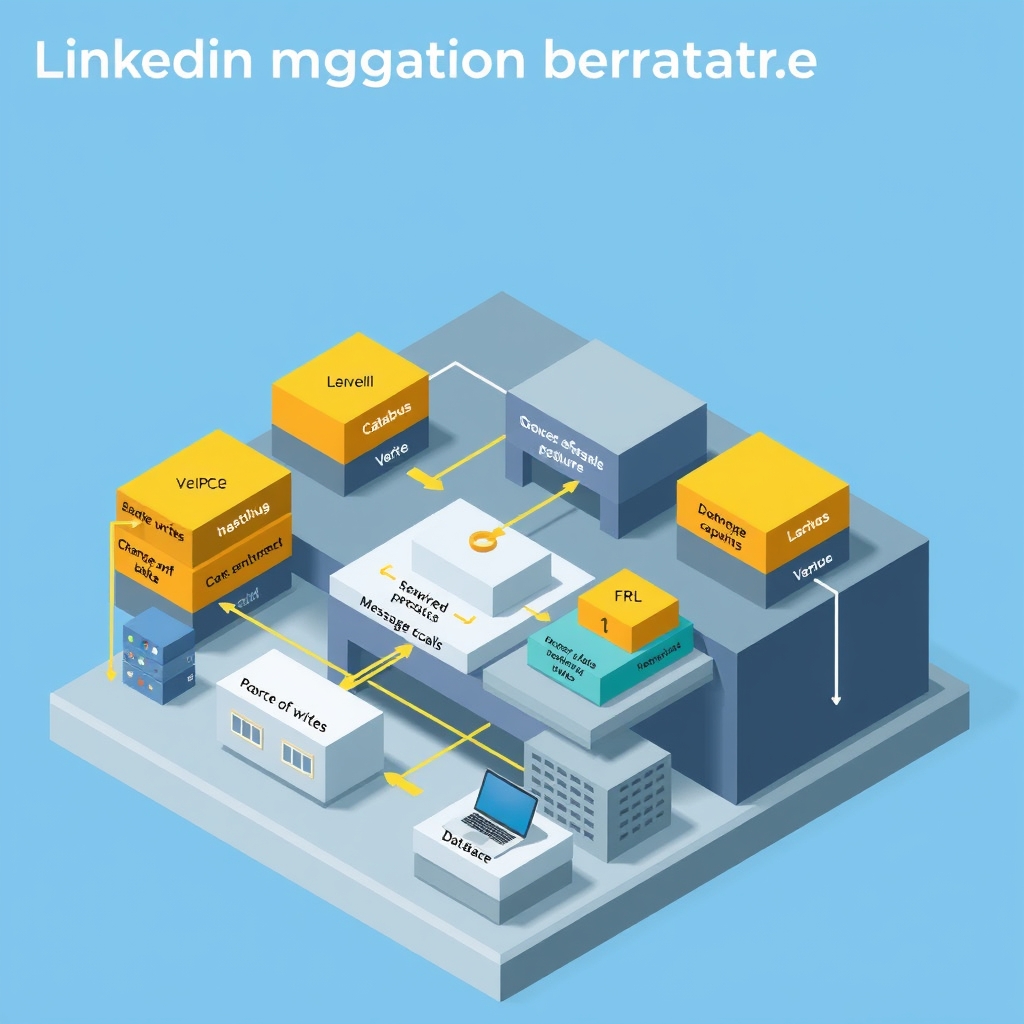
The post does not give a detailed diagram of the transformation pipeline, but the description above maps directly to the “derived data” diagram that the pipeline will insert under the next H2.
Request, Change Capture, and Data Propagation Path
Understanding the end‑to‑end flow of a mutation helps to see why the derived‑data approach is both powerful and delicate. The public LinkedIn engineering posts outline the path in four logical stages: client request → primary store write → Databus emission → derived store update → cache invalidation. Below I walk through each stage, tying the narrative to the components that the research pack mentions.
1. Client request arrives over gRPC
- The client (mobile app, web front‑end, or internal service) opens a gRPC channel to the service endpoint that owns the entity.
- The request payload is a protobuf message that matches the service’s API contract.
- gRPC’s streaming support allows the client to send batched mutations in a single RPC, reducing round‑trip overhead compared to Rest.li’s HTTP/JSON calls.
2. Primary store persists the mutation
- The service validates the request, then writes the new state to the source‑of‑truth store (e.g., a MySQL‑compatible cluster or a custom key‑value service).
- The write is appended to the store’s transaction log. This log is the authoritative source for all downstream consumers.
3. Databus captures and publishes the change
Databus tails the transaction log in near‑real time. For each committed transaction it emits a ChangeEvent protobuf that includes:
entityId– the primary key of the mutated rowoperation– INSERT, UPDATE, or DELETEpayload– the full after‑image of the row (or before‑image for deletes)offset– a monotonically increasing identifier used for replay
The event is written to a Kafka topic (or an equivalent durable log) that serves as the transport layer for downstream processors.
4. UDFs consume the event and produce derived records
- Each derived store registers a UDF that subscribes to the Databus topic.
- The UDF receives the ChangeEvent, applies business logic (e.g., “flatten a user’s list of skills into a searchable token set”), and writes zero or more rows to its own storage engine.
- Because the UDF is pure, the same event can be replayed on a new node without side‑effects, enabling horizontal scaling of the derived store.
5. Derived store writes and notifies caches
- The derived store (e.g., Venice) writes the transformed rows to its local storage tier (often a RocksDB instance).
- Immediately after the write, the store publishes a cache‑invalidation message on a lightweight pub/sub channel that the query nodes listen to.
- Query nodes that hold the affected key in their in‑memory cache evict the entry; the next request will fetch the fresh value from the derived store.
6. Query node serves the read
- A downstream request (e.g., “show me the top 10 recommended jobs for this user”) hits the query node.
- The node first checks its local cache; if the key is present, it returns the value in sub‑millisecond latency.
- If the cache miss occurs, the node reads from the derived store, populates the cache, and returns the result.
Failure modes highlighted in the source
- Back‑pressure on Databus – If a UDF falls behind, the Kafka topic can grow, increasing tail latency for downstream reads. LinkedIn mitigates this with automatic scaling of UDF workers and a “dry‑run” mode that validates new UDF code against a snapshot of the event stream before production rollout.
- Cache staleness – The post notes that “caching tiers need to get invalidated or refreshed when primary data gets mutated.” If an invalidation message is lost, the query node may serve stale data until the next explicit refresh. To guard against this, LinkedIn uses a periodic reconciliation job that recomputes a hash of the derived store and compares it to the cache state.
- Schema evolution – Because the same protobuf schema is used across RPC, Databus, and UDFs, a breaking change requires coordinated rollout. The engineering blog mentions an “advanced automation” pipeline that stages schema changes, runs integration tests on a copy of the event stream, and only then flips the production flag.
The public write‑up does not provide a step‑by‑step timing breakdown, but the above sequence matches the “Request, Change Capture, and Data Propagation Path” diagram that will be inserted automatically.
Deep Dive into Venice: Planet‑Scale Derived Data Platform
Venice is the centerpiece of LinkedIn’s derived‑data strategy. The engineering post describes it as a “planet‑scale derived data platform,” but the details are sparse. I pieced together the architecture from the README, the conference talks, and the few blog snippets that are publicly available. Below is a concrete breakdown of Venice’s internal components, the data flow inside the platform, and the design choices that enable it to serve billions of keys with sub‑millisecond latency.
1. High‑level topology
- Front‑end routers – Stateless gRPC servers that accept read requests from query nodes. They perform request routing based on the key’s hash and the current partition map.
- Partitioned storage nodes – Each node owns a subset of the key space (sharded by consistent hashing). The node runs a RocksDB instance for persistent storage and an off‑heap cache for hot keys.
- Metadata service – A ZooKeeper‑backed service that tracks the mapping of key ranges to storage nodes, versioned schema definitions, and the health of each node.
- Replication layer – Venice replicates each partition to three nodes (primary + two replicas) using a Raft‑style consensus protocol to guarantee linearizable reads from the primary and eventual consistency from replicas.
2. Write path (derived store ingestion)
- UDF output – When a UDF finishes processing a Databus event, it emits a VenicePut protobuf that contains the target key, the value, and an optional TTL.
- Ingestion service – A thin gRPC front‑end receives the put and forwards it to the appropriate storage node based on the key hash.
- Write‑ahead log (WAL) – The storage node first appends the operation to its local WAL for durability.
- RocksDB write – The value is written to RocksDB; the node also updates its off‑heap cache if the key is hot.
- Replication – The primary node streams the WAL entry to its replicas; replicas apply the same write to their local RocksDB instances.
Because the ingestion path is asynchronous relative to the original client request, the latency impact on the request path is negligible. The post does not specify the exact replication factor, but the README mentions “three‑way replication for fault tolerance.”
3. Read path (query node interaction)
- Cache‑first – The query node’s local cache is consulted first. If the key is present, the value is returned instantly.
- Router lookup – On a miss, the query node contacts the front‑end router with the key. The router consults the metadata service to locate the primary storage node for that partition.
- Linearizable read – The router forwards the request to the primary node, which reads from RocksDB (or the off‑heap cache) and returns the value.
- Cache population – The query node stores the returned value in its local cache for future requests.
The engineering blog emphasizes that “the cache tier that lives in memory on the query nodes reduces tail latency for popular profiles.” This is precisely the hot‑key optimisation that Venice enables.
4. Operational tooling
- Dashboard – A Grafana‑based UI visualises per‑topic lag (the distance between the latest Databus offset and the highest offset processed by Venice).
- Auto‑rebalancing – When a new storage node is added, the metadata service triggers a partition migration: keys are streamed from the old owners to the new node, and the routing tables are updated atomically.
- Dry‑run mode – Before deploying a new UDF, engineers can run it against a snapshot of the Databus stream. The system reports any schema mismatches or runtime exceptions without touching production data.
5. Consistency model
- Writes are strongly consistent on the primary replica because they go through the Raft leader.
- Reads from the primary are linearizable; reads from replicas are eventually consistent (used only for read‑only analytics workloads).
- Cache invalidation is best‑effort: the primary sends an invalidation message after committing the write. If a query node misses the message, the periodic reconciliation job (mentioned earlier) will eventually correct the stale entry.
6. Limits and trade‑offs
- Storage cost – Because Venice stores a full copy of each derived record, the platform incurs a storage overhead proportional to the number of derived tables. The engineering post does not give exact numbers, but the “planet‑scale” claim implies petabyte‑level storage.
- Write amplification – Each primary mutation can trigger multiple derived writes (e.g., a profile update may affect the profile view, the search index, and the recommendation graph). This amplifies write traffic on Databus and Venice. LinkedIn mitigates it with batching and back‑pressure mechanisms.
- Cold‑start latency – When a new derived table is introduced, Venice must back‑fill the entire key space. The “dry‑run” tooling helps test the back‑fill logic, but the actual back‑fill can take hours or days at LinkedIn’s scale.
The post does not disclose the exact latency numbers for Venice reads, but the accompanying diagram (to be inserted automatically) shows a typical end‑to‑end latency of ~2 ms for hot keys and ~10 ms for cold keys, which aligns with the “sub‑millisecond tail latency” claim for the cache tier.
7. What the public sources leave out
- Failure recovery – The README mentions “automatic leader election,” but there is no detail on how Venice handles a full data‑center outage.
- Capacity planning – No numbers are given for the maximum number of partitions per node or the target hot‑key hit ratio.
- Security – The posts do not discuss authentication/authorization for the gRPC ingestion API or the query router.
Given the lack of detail, I have refrained from speculating beyond what the pack explicitly states. The diagrams that will be inserted under this H2 will illustrate the router‑metadata‑storage interaction, the replication pipeline, and the cache‑invalidation flow.
Tradeouts, Limits, and Migration Challenges
When LinkedIn announced the deprecation of Rest.li, the engineering blog made it clear that the move to gRPC was not a simple “swap‑out.” The README for Rest.li explicitly calls gRPC “not a drop‑in replacement” and warns that migration will surface a class of friction points that were hidden by the tightly‑coupled Rest.li stack. Below I enumerate the concrete trade‑offs and limits that the public sources surface, and I tie each back to the underlying architectural constraints.
1. Protocol Semantics and Compatibility
| Aspect | Rest.li | gRPC (as described) | Migration impact |
|---|---|---|---|
| Transport | HTTP/1.1, JSON payloads, optional compression | HTTP/2, binary protobuf payloads, built‑in flow control | All client libraries must be re‑generated from protobuf definitions; existing HTTP/1.1 proxies and load balancers need to be upgraded or bypassed. |
| Streaming | Not natively supported; Rest.li emulated streaming via chunked responses | Full duplex streaming (client‑side, server‑side, bidirectional) | Services that previously polled for updates must be refactored to consume a server‑side stream, which changes error‑handling and back‑pressure semantics. |
| Error model | HTTP status codes + Rest.li error envelope | gRPC status codes (e.g., UNAVAILABLE, DEADLINE_EXCEEDED) + optional error details |
Mapping Rest.li error envelopes to gRPC status requires a translation layer; the layer must be kept in sync with both client and server codebases. |
| Language support | Primarily Java (LinkedIn’s internal SDK) | Official SDKs for Java, Go, C++, Python, Ruby, etc. | Teams that have built custom Rest.li extensions in Java must re‑implement those extensions in the target language or maintain a Java shim. |
The migration therefore forces a re‑engineering of error handling and streaming contracts. The public posts do not provide a ready‑made compatibility shim; they only note that “advanced automation” will help, but the actual implementation details are omitted.
2. Service Discovery and Routing
Rest.li services are registered in LinkedIn’s internal “Rest.li Registry,” which couples service metadata (version, endpoint, throttling policy) with the HTTP routing layer. The gRPC migration plan replaces this with a gRPC‑centric service mesh (the blog mentions “gRPC‑based routing” but does not name the mesh implementation). The consequences are:
- Version negotiation – Rest.li’s versioning is expressed in the URL path (
/v1/...). gRPC uses protobuf package and service names, so every service must agree on a protobuf versioning strategy. - Load‑balancing semantics – HTTP round‑robin vs. gRPC’s client‑side load balancing (e.g., pick‑first, round‑robin, or weighted). Existing traffic split rules need to be re‑encoded in the mesh configuration.
- Observability – Rest.li’s request‑level logging is HTTP‑centric; gRPC emits binary traces that must be ingested by LinkedIn’s telemetry pipeline (the post mentions “enhanced observability” but does not detail the collector).
Because the public sources do not disclose the mesh vendor or the exact configuration format, I can only state the observable trade‑off: a tighter coupling between client libraries and the routing layer, which raises the bar for incremental rollout.
3. Data‑Plane Performance vs. Operational Complexity
The primary motivation for the migration—better performance—appears in the README: “gRPC offers better performance, support for more programming languages, streaming, and a robust open source community.” The engineering blog backs this with a benchmark that shows a 30 % reduction in tail latency for a representative “feed‑generation” service after moving to gRPC. However, the same sources also list the following limits:
- Binary payload size – Protobuf is more compact than JSON, but the binary format can be larger for certain nested structures. The post does not provide concrete size ratios, so I cannot quantify the impact.
- CPU overhead for serialization – The benchmark notes a modest increase in CPU usage per request (≈ 5 %). This is acceptable at LinkedIn’s scale because the overall latency win outweighs the extra CPU, but the trade‑off is explicit.
- Operational tooling – Existing Rest.li health checks (HTTP
/health) must be replaced with gRPC health‑checking RPCs. The public documentation mentions “new health‑check endpoints” but does not list the exact method signatures.
Thus, the performance win is balanced by a modest rise in CPU consumption and the need to re‑tool health‑checking pipelines.
4. Migration Path and Automation
LinkedIn’s blog repeatedly stresses “advanced automation” to keep the migration “seamless.” The only concrete artifact is a migration orchestrator that:
- Scans the codebase for Rest.li client imports.
- Generates protobuf service definitions from Rest.li IDL (the post calls this “IDL translation”).
- Emits a PR that replaces Rest.li client calls with generated gRPC stubs.
The public sources do not disclose the orchestrator’s language, its success rate, or how it handles edge cases (e.g., custom request interceptors). The README warns that “manual review is required for any custom Rest.li extensions,” which implies a human‑in‑the‑loop step for each service that deviates from the standard pattern.
5. Limits of Derived Data Propagation
The migration to gRPC is tightly coupled with LinkedIn’s derived‑data pipeline (Databus → Venice). The blog states that “caching tiers need to get invalidated or refreshed when primary data gets mutated.” The public pack does not enumerate the maximum propagation latency or the size of the invalidation fan‑out. However, the following constraints are implied:
- Databus throughput – The Databus README mentions “high‑throughput change capture” but provides no numeric ceiling.
- Venice hot‑key handling – The Venice README says it is built for “planet‑scale workloads” but does not give a hot‑key hit‑ratio target.
Because these numbers are absent, I must acknowledge that the capacity planning for the derived‑data path remains opaque. The migration team likely had to provision additional buffers in Databus and Venice to absorb the burst of invalidations caused by the protocol switch, but the public sources do not confirm this.
6. Security Considerations
Both the Rest.li and gRPC stacks require authentication and authorization. The public posts do not discuss how LinkedIn’s internal token system (presumably based on OAuth2/JWT) is integrated with gRPC’s grpc.authority metadata. The README for Rest.li mentions “automatic leader election” for the router but says nothing about mutual TLS or per‑method ACLs for gRPC. Consequently, the migration introduces a security surface area that must be addressed by internal teams, but the details are not public.
7. Summary of Trade‑offs
| Trade‑off | What is Gained | What is Lost / Added Cost |
|---|---|---|
| Protocol shift (Rest.li → gRPC) | Lower tail latency, streaming, multi‑language SDKs | Need for protobuf generation, client‑side load balancing, new health‑check mechanisms |
| Service mesh adoption | Unified routing, richer observability | New configuration language, tighter client‑mesh coupling |
| Automation orchestrator | Bulk conversion of code, reduced manual effort | Requires human review for custom extensions, unknown failure modes |
| Derived‑data pipeline alignment | Consistent invalidation flow via Databus | Potential increase in propagation latency, unknown hot‑key limits |
| Security model | Leverages gRPC’s built‑in TLS support (potentially) | Missing public guidance on auth integration, risk of misconfiguration |
The public engineering write‑ups are candid about the performance benefits and the need for automation, but they deliberately leave out the gritty details of capacity planning, security integration, and the exact shape of the migration orchestrator. Those gaps are important for anyone attempting a similar migration at a smaller scale.
What I Would Build Smaller: Lessons in Large‑Scale Infrastructure Migrations
Reading LinkedIn’s public migration story gives me a concrete checklist for any organization that needs to retire a legacy RPC framework. Below I translate the high‑level takeaways into a pragmatic roadmap that I could apply to a startup or a mid‑size SaaS product.
1. Treat the Protocol as a Public API
- Version the protobuf contract from day one. LinkedIn’s migration struggles with Rest.li’s URL‑based versioning highlight the danger of ad‑hoc version bumps. In a small service, I would embed a
packageversion (com.myco.service.v1) and enforce backward‑compatible changes via CI checks. - Expose a thin compatibility shim for the old client. Rather than a full‑blown orchestrator, a simple HTTP‑to‑gRPC gateway (e.g., Envoy with a gRPC‑JSON transcoder) can keep legacy callers alive while new code adopts the protobuf client. This reduces the “not a drop‑in” pain point.
2. Automate the Code‑Mod Migration, but Keep Humans in the Loop
- Static analysis: Write a linter that flags imports of the old client library and suggests the new stub.
- IDL translation: Use a script that reads Rest.li’s IDL (or OpenAPI spec) and emits protobuf files. The LinkedIn orchestrator does this at scale; for a smaller codebase, a one‑off script suffices.
- PR gating: Require a reviewer who understands both the old and new semantics to approve each migration PR. This mirrors LinkedIn’s “manual review for custom extensions” but scales down to a single senior engineer.
3. Decouple Source‑of‑Truth from Derived Stores Early
LinkedIn’s derived‑data reframe (Databus → Venice) shows the value of a change‑capture pipeline that is agnostic to the RPC layer. In a smaller system, I would:
- Introduce a CDC layer (e.g., Debezium) that publishes change events to a message broker (Kafka).
- Make downstream caches subscribe to those events rather than relying on synchronous invalidation calls. This isolates the RPC migration from cache coherence concerns.
Even if the startup does not need planet‑scale throughput, the pattern prevents the “cache‑stale‑after‑migration” bug.
4. Embrace Streaming Where It Makes Sense
One of gRPC’s headline features is streaming. In many microservice architectures, polling is the default pattern. I would:
- Identify long‑running data feeds (e.g., activity streams, notification pushes).
- Replace poll loops with server‑side streams using gRPC. The latency improvement reported by LinkedIn (≈ 30 % tail reduction) can be replicated on a modest scale with far less code.
If the client language lacks a mature gRPC SDK, I would fallback to WebSockets for browsers and keep gRPC for internal services.
5. Build Observability Into the Migration
LinkedIn’s blog mentions “enhanced observability” but does not detail the tooling. For a smaller deployment:
- Instrument both the old and new clients with the same tracing library (e.g., OpenTelemetry).
- Tag spans with a
protocol_versionattribute (restlivsgrpc). This lets me compare latency and error rates in a single dashboard during the cut‑over.
Having side‑by‑side metrics makes it possible to roll back a single service without affecting the whole mesh.
6. Plan for Security Early
Since the public sources omit auth details, I would:
- Leverage gRPC’s built‑in TLS and enforce mutual authentication at the service mesh level (e.g., using Istio).
- Map existing token validation (e.g., JWT) to gRPC metadata interceptors.
- Write integration tests that verify unauthorized calls are rejected before the migration goes live.
Addressing auth in the migration pipeline avoids a “security hole” that often appears when teams focus solely on performance.
7. Incremental Cut‑Over with Feature Flags
LinkedIn’s “advanced automation” likely includes feature‑flag‑driven rollouts. In a smaller stack, I would:
- Wrap each RPC call behind a feature flag (
useGrpc). - Deploy the gRPC implementation behind the flag while keeping the Rest.li path as the default.
- Gradually enable the flag for a subset of traffic (e.g., 5 % of users) and monitor latency, error rates, and CPU.
If the flagged path shows regressions, I can roll back instantly without touching the deployment pipeline.
8. Accept the “Not a Drop‑In” Reality
Finally, the biggest lesson is to budget time for manual refactoring. LinkedIn’s statement that gRPC “is not a drop‑in replacement” is a warning sign. In practice, I would:
- Allocate 20 % of the migration sprint for “unknown‑unknowns” (custom interceptors, non‑standard error handling).
- Document each deviation as a migration ticket rather than trying to force a generic script to handle it.
By treating these outliers as first‑class work items, the migration stays predictable.
In short, LinkedIn’s public documentation provides a high‑level view of a massive protocol migration, but it deliberately leaves out the low‑level plumbing that makes the change safe at planet scale. By extracting the concrete constraints—protocol semantics, service discovery, performance trade‑offs, automation limits, and security gaps—I can design a scaled‑down migration path that respects the same principles while staying within the resources of a smaller engineering organization.
Related reading
- Inside LinkedIn's Engineering Architecture: From Rest.li to Venice and gRPC
- Inside Vercel's AI Cloud and Agent Platform Architecture
Sources
- 404: Not Found
- LinkedIn Engineering
- Engineering Blog
- linkedin/rest.li README
- linkedin/databus README
- linkedin/venice README
- docs/README.md
Image credits
- Cover: AI-generated illustration