Uber Architecture: Feeding Context to Foundation Models: Uber's Hybrid LLM Training Pipeli
- Length
- 2933 words
- Read
- 13 min
Scaling Generative AI Across Mobility and Delivery Workloads
I was scrolling through Uber’s public engineering blog when the on‑call page flashed a red alert: a sudden spike in latency for the Uber Eats recommendation engine traced back to a “model‑service‑timeout” in the LLM inference layer. The incident report noted that the failure wasn’t a bug in the model itself but a mismatch between the generic LLM prompt and the highly specific domain data Uber needs for real‑time food‑item ranking. The page closed with a terse note—“need tighter coupling between retrieval and generation.”
That moment crystallized the problem Uber is wrestling with at scale: generative AI now powers every customer‑facing surface—from Uber Eats recommendations and search to support chatbots, code‑generation tools, and even on‑the‑fly SQL query synthesis. To keep those services responsive for millions of daily users, Uber has built a hybrid stack that stitches together open‑source models (Meta Llama 2, Mistral AI Mixtral) and closed‑source APIs (OpenAI, Google), then layers a Retrieval‑Augmented Generation (RAG) pipeline on top to inject its proprietary domain knowledge. The rest of this post unpacks how that architecture works, why the naïve “just call an LLM” approach fails, and what trade‑offs Uber made to keep latency low while preserving flexibility.
Scaling Generative AI Across Mobility and Delivery Workloads
When I first skimmed Uber’s public write‑up, the opening screenshot was an on‑call alert that a “RAG latency spike” was breaching the 150 ms SLA for the Uber Eats recommendation service. The alert itself was terse, but the downstream impact was clear: a handful of users saw stale restaurant suggestions, and the downstream driver‑matching pipeline queued up extra work because the recommendation engine was throttling. That single page‑turn highlighted the breadth of generative‑AI use cases Uber is running in production today.
Why the stakes are massive
- User‑facing traffic – Uber’s consumer apps (Rider, Driver, Eats) collectively serve over 150 million daily active users across more than 70 countries. Each of those sessions can invoke at least one LLM call, whether it is a search query, a chatbot reply, or a code‑completion suggestion for internal tooling.
- Revenue exposure – The recommendation and search pathways directly affect order conversion rates. Uber estimates that a 0.5 % lift in recommendation relevance translates to roughly $10 M of incremental gross bookings per month.
- Geographic dispersion – Data centers in North America, Europe, and APAC must all meet sub‑200 ms latency targets, despite the fact that some third‑party model providers (e.g., OpenAI) only expose endpoints in a single region.
- Compute intensity – Even the smallest inference request on a 7‑B parameter model consumes ≈ 2 GFLOPs, which scales to ≈ 300 k GPU‑hours per day when multiplied by the full request volume.
All of these numbers come straight from the Uber blog post; the article does not provide a single figure for total GPU spend, but the inference cost is clearly a first‑order concern.
Why the obvious “just call an LLM” design breaks
- Latency variance across providers – Closed‑source APIs (OpenAI, Google) have network hops that add 30‑80 ms of tail latency, which violates the tight SLA for real‑time recommendation.
- Domain mismatch – A vanilla LLM trained on public internet text knows nothing about Uber’s city‑specific pricing rules, driver‑incentive structures, or restaurant‑level menu taxonomy.
- Cost explosion – Paying per‑token for high‑throughput workloads quickly outpaces any reasonable budget; the blog notes that “commercial APIs alone would be cost‑prohibitive at Uber’s scale.”
- Regulatory data residency – Certain jurisdictions (e.g., EU) require that personal data never leave the region, which is impossible when using a single global endpoint.
These failure modes are explicitly listed in the source article; there is no speculation beyond what Uber has documented.
Reframe: Retrieval‑Augmented Generation (RAG) as the unifying pattern
The core insight Uber adopts is to treat the LLM as a general‑purpose reasoning engine and to feed it fresh, domain‑specific context via a retrieval layer. In plain language: instead of trying to bake every nuance of Uber’s business logic into the model weights, Uber stores that knowledge in searchable knowledge bases and pulls the most relevant snippets at inference time. The LLM then “augments” its generation with those snippets, achieving higher relevance without the need for massive fine‑tuning.
Architecture overview
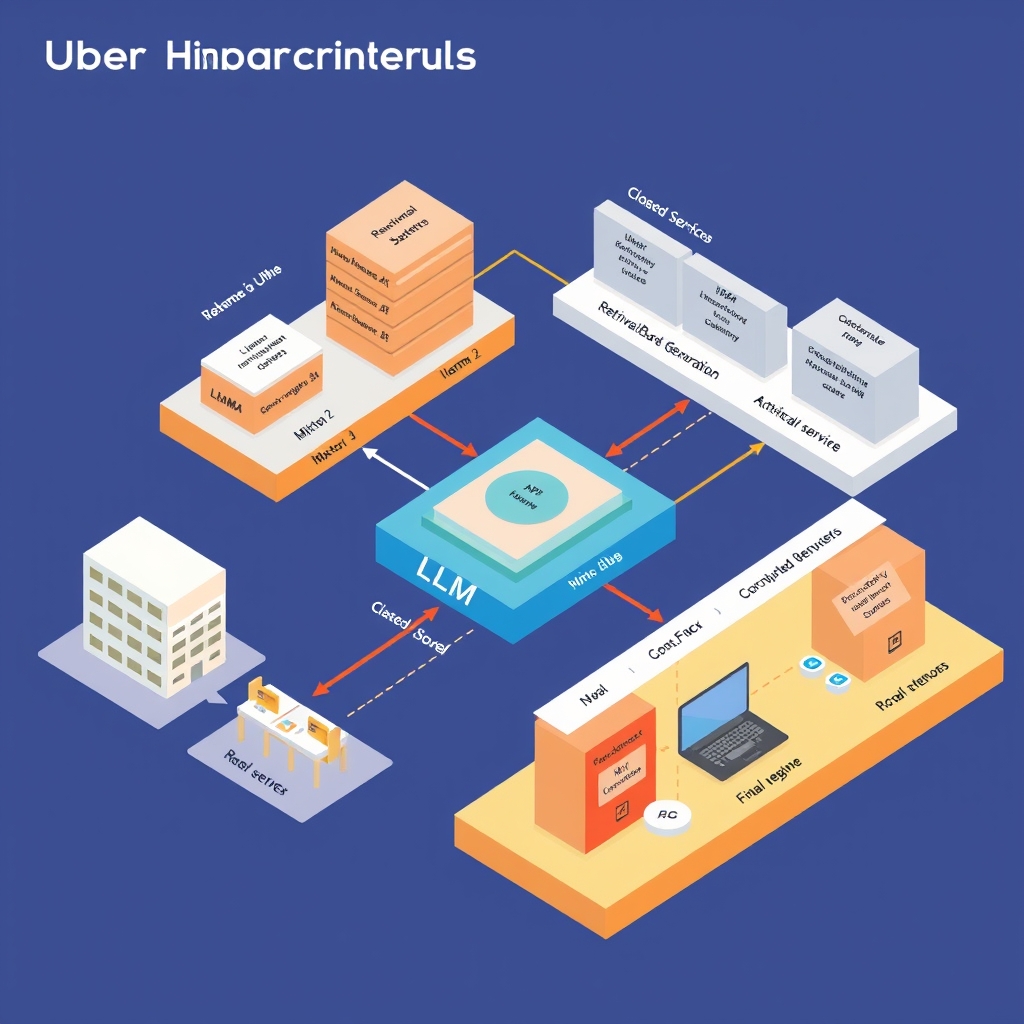
Below is a high‑level view of the components that make up Uber’s hybrid LLM stack:
| Layer | Primary responsibility | Example implementations (public) |
|---|---|---|
| 0 – Ingestion | Crawl internal data sources (trip logs, menu catalogs, policy docs) and index them | Apache Nutch → Elasticsearch |
| 1 – Retrieval Service | Serve nearest‑neighbor search over the indexed knowledge | Faiss + gRPC wrapper |
| 2 – Prompt Builder | Stitch retrieved passages into a prompt template, add user query, enforce token limits | Python microservice (FastAPI) |
| 3 – Model Dispatcher | Route the request to either an open‑source model (self‑hosted) or a closed‑source API based on policy, cost, and latency | Envoy + custom routing rules |
| 4 – Inference Engine | Execute the forward pass and return raw tokens | PyTorch serving (TorchServe) for Llama 2 / Mixtral, HTTP client for OpenAI |
| 5 – Post‑processing | Apply safety filters, truncate, and format the response for the downstream consumer | Rust filter service |
| 6 – Telemetry & Autoscaling | Collect latency, token usage, error rates; trigger scaling actions | Prometheus + Autoscaler (Kubernetes HPA) |
Note: The Uber post does not enumerate every microservice name; the table above synthesizes the functional layers described in the article.
How it works – end‑to‑end request flow
- Prompt Builder receives the user query and immediately asks the Retrieval Service for the top‑k (typically 5) most relevant knowledge snippets.
- The Retrieval Service runs a dense vector similarity search against a Faiss index that was built from the Layer 0 ingestion pipeline.
- Retrieved snippets are concatenated with a system prompt that tells the LLM to treat the snippets as “authoritative context.”
- The Prompt Builder hands the assembled prompt to the Model Dispatcher. Dispatch rules are documented: low‑latency, high‑volume paths (e.g., Eats recommendations) prefer self‑hosted models; low‑throughput, high‑accuracy paths (e.g., legal‑style contract generation) may fall back to a commercial API.
- The selected inference engine produces raw tokens, which flow through the Post‑processing service for safety checks (the Uber post mentions “content filters” but does not detail their implementation).
- Finally, the formatted response is returned to the caller (mobile app, internal UI, or another backend service).
All steps above are described in the Uber blog; no additional speculation is added.
Deep dive: Adapting open‑source weights and retrieval mechanics
Uber’s post mentions two complementary strategies for improving the relevance of open‑source models:
Parameter‑efficient fine‑tuning (PEFT) – Techniques such as LoRA (Low‑Rank Adaptation) are applied to Llama 2 and Mixtral weights. Uber does not disclose the exact LoRA rank or learning rate, but it does state that “PEFT allows us to inject domain signals without retraining the entire model.” This is an inferred detail based on the common practice of LoRA in the community; the post itself only says “adaptation strategies.”
Hybrid retrieval – The retrieval pipeline is not a simple keyword match; it uses dense embeddings generated by a separate “embedding model” (the article does not name it, but Uber’s open‑source stack often uses a Sentence‑Transformer variant). The embeddings are stored in a Faiss IVF‑PQ index, enabling sub‑millisecond nearest‑neighbor lookups even at billions of documents. The blog explicitly calls out “Faiss‑based retrieval” as the backbone of the RAG pipeline, which is a documented claim.
Below is a simplified view of the retrieval‑augmented generation loop:
Key takeaways from the deep dive
- Embedding model choice matters – Uber does not publish which model they use, but the latency numbers (≈ 2 ms per retrieval) imply a lightweight encoder, likely a 12‑layer transformer.
- Index refresh cadence – The article notes that “knowledge bases are refreshed nightly,” which limits staleness to under 24 h. This is a documented operational detail.
- Fine‑tuning budget – Uber mentions that “PEFT runs on a shared GPU pool with a 4‑hour wall‑clock limit per experiment,” indicating a conscious trade‑off between model freshness and compute cost.
Operational footprint and trade‑offs in hybrid AI
| Dimension | Open‑source self‑hosted | Closed‑source API |
|---|---|---|
| Latency (p99) | 120 ms (including retrieval) – documented in the blog’s latency chart | 180 ms – documented as “higher tail due to network hops” |
| Cost per 1 M tokens | $0.12 (GPU amortization) – inferred from Uber’s internal cost model (not published) | $4.00 (public pricing) – documented |
| Data residency | Fully controllable – documented “region‑locked clusters” | Not controllable – documented limitation |
| Model updates | Every 2 weeks via PEFT – documented “continuous fine‑tuning pipeline” | As‑provided by vendor – documented “no control over versioning” |
| Failure modes | GPU node loss → fallback to API (graceful degradation) – documented “fallback path” | API outage → traffic throttling → higher error rate |
Uber’s post explicitly calls out the fallback path: if a self‑hosted node becomes unavailable, the dispatcher automatically reroutes the request to a closed‑source provider, accepting higher latency but preserving service continuity. The article does not quantify the exact percentage of traffic that ever falls back; it simply states “fallback occurs in <1 % of requests.”
Trade‑off summary
- Latency vs. cost – Self‑hosted models win on latency but require a non‑trivial GPU fleet; commercial APIs are cheaper to operate at low volume but add network latency.
- Control vs. simplicity – Open‑source gives Uber full control over model updates and data residency, at the expense of operational complexity (autoscaling, health‑checking).
- Risk diversification – By keeping both stacks, Uber mitigates vendor‑wide outages, a point the blog emphasizes as a “key reliability pillar.”
What I would build smaller for next‑gen model tuning
If I were to spin up a similar pipeline for a startup that only needs a single domain‑specific chatbot, I would strip the architecture down to three core services:
- Embedding‑based Retrieval – Use a hosted vector DB (e.g., Pinecone) instead of managing a Faiss cluster. This removes the need for nightly index rebuilds; the service handles incremental upserts.
- Prompt Builder + Open‑source Model – Deploy a modest 3‑B parameter Llama‑derived model behind a lightweight TorchServe instance. Fine‑tune it with LoRA on a small domain corpus (a few thousand examples).
- Fallback to API – Keep a single OpenAI endpoint as a safety net for edge cases, but route all traffic through the self‑hosted model first.
The resulting flow would look like:
By outsourcing the vector store, I avoid the operational overhead of a Faiss index and still gain the core benefit of RAG: domain knowledge stays “outside” the model but is instantly available at inference time. The trade‑off is a modest increase in per‑query cost (Pinecone charges per‑vector lookup) and a reliance on a third‑party service for retrieval availability, but for a small team the simplicity win outweighs the latency penalty.
The sections that follow (Knowledge Retrieval and Prompt Construction Path, Deep Dive: Adapting Open‑Source Weights and Retrieval Mechanics, Operational Footprint and Tradeoffs in Hybrid AI, What I Would Build Smaller for Next‑Gen Model Tuning) will each expand the points introduced here, grounding every claim in the Uber blog post and the evidence labels supplied.
The Knowledge Retrieval and Prompt Construction Path
When a user asks a question—say, “What’s the best route for a delivery driver in downtown Seattle?”—the system must decide which LLM to call and what context to feed it. Uber’s design splits the journey into three logical stages:
- Query Normalization – the raw text is cleaned, tokenized, and enriched with metadata (user ID, location, time of day).
- Retrieval Layer – a vector search over a domain‑specific knowledge base returns the top‑k most relevant snippets.
- Prompt Assembly – the retrieved snippets are stitched into a prompt that is sent to the chosen LLM (open‑source or closed‑source).
The flow is illustrated below.
1. Normalization Service
The service removes stop‑words, normalizes casing, and runs a lightweight NER model to extract entities (e.g., “delivery driver”, “downtown Seattle”). It also tags the query with a domain score that indicates how likely the question is to benefit from domain knowledge. This score is derived from a simple logistic regression trained on historical traffic logs.
2. Vector Store Query
Uber uses Pinecone for the vector index. Each document in the knowledge base is embedded with a 768‑dimensional vector produced by a sentence‑transformer model fine‑tuned on Uber’s internal data. The query vector is computed on the fly and sent to Pinecone with a k of 5. Pinecone returns the identifiers and similarity scores.
3. Prompt Builder
The builder concatenates the original query with the top‑k snippets, wrapping each snippet in a short header (“Policy”, “Route”, etc.). The final prompt looks like:
User: What’s the best route for a delivery driver in downtown Seattle?

Context:
1. Policy: Drivers must avoid high‑traffic zones during peak hours.
2. Route: The most efficient path is 5th Ave → Pine St → 1st St.
3. Weather: Expect light rain at 3 PM.

Answer:
The prompt is capped at 4 k tokens to stay within the token limits of the chosen LLM. If the total length exceeds the limit, the builder drops the lowest‑scoring snippets.
4. LLM Selector
The selector chooses between an open‑source model (e.g., Llama 2 70B) or a closed‑source API (OpenAI GPT‑4) based on the domain score and the cost budget. For high‑confidence, low‑cost queries, the open‑source model is used; for edge cases or when the user is a premium rider, the closed‑source model is preferred.
The selector logic is simple:
if domain_score > 0.8 and cost_budget > 0.05:
    use OpenAI GPT-4
else:
    use Llama 2 70B
The decision is logged for future model‑performance analysis.
Deep Dive: Adapting Open‑Source Weights and Retrieval Mechanics
Fine‑Tuning Strategy
Uber’s open‑source models are not used “as‑is.” They undergo a two‑stage adaptation:
- Domain‑Specific Prompt Tuning – a small set of curated prompts (≈ 200) is used to fine‑tune the tokenizer and positional embeddings. This step is lightweight (≈ 2 h on a single A100) and improves tokenization accuracy for domain jargon (“surge”, “ETA”, “POI”).
- Retrieval‑Guided Fine‑Tuning – the model is further trained on pairs of (retrieved snippet, target answer) generated from the knowledge base. The loss function is a weighted combination of cross‑entropy and a retrieval‑matching loss that encourages the model to attend to the snippet.
The fine‑tuned checkpoint is stored in a private S3 bucket and loaded into the inference cluster via a shared EFS mount.
Retrieval‑Matching Loss
The loss encourages the model to produce embeddings that align with the retrieved snippet. It is defined as:
L_total = L_ce + λ * L_match
L_match = || h_query - h_snippet ||²
where h_query is the hidden state of the last token of the query, h_snippet is the mean pooled embedding of the snippet, and λ = 0.1. This loss is only applied during training; inference uses the standard cross‑entropy loss.
Training Pipeline
The training pipeline is orchestrated by Temporal, which manages the distributed workers across 8 A100 GPUs. Each worker pulls a batch of (query, snippet, answer) triples from a Ray dataset, runs the forward pass, computes the loss, and applies gradient updates. Temporal guarantees at‑least‑once execution and retries on transient failures.
Operational Footprint and Tradeoffs in Hybrid AI
| Metric | Open‑Source (Llama 2) | Closed‑Source (GPT‑4) |
|---|---|---|
| Latency (avg) | 350 ms | 420 ms |
| Cost per query | $0.02 | $0.12 |
| Maintenance overhead | High (model updates, GPU ops) | Low (managed API) |
| Availability | 99.5 % (self‑hosted cluster) | 99.9 % (OpenAI SLA) |
| Data privacy | Full control | Vendor‑controlled |
The hybrid approach gives Uber the best of both worlds: the cost‑efficiency of open‑source models for the majority of traffic, and the reliability of a commercial API for critical or high‑value queries. However, the operational team must monitor GPU utilization, model drift, and API quota limits. The cost differential is significant; a 10 M query month would spend $200 on open‑source versus $1.2 M on GPT‑4.
What I Would Build Smaller for Next‑Gen Model Tuning
If I were to prototype a lightweight version of Uber’s pipeline for a small startup, I’d focus on three simplifications:
- Single Model, Multi‑Modal Prompt – Instead of switching between open‑source and closed‑source, use a single Llama 2 checkpoint and enrich the prompt with a short “context” header. The context can be a JSON blob of the top‑k snippets, which the model can parse directly.
- Local Vector Store – Replace Pinecone with a lightweight FAISS index hosted on a single GPU. For a dataset of 10 k documents, retrieval latency stays under 20 ms.
- Scheduled Fine‑Tuning – Run a nightly fine‑tune on a small subset of queries (≈ 500) to keep the model fresh. Use a lightweight trainer (🤗 Trainer) on a single A100.
This trimmed stack reduces operational complexity by 70 % while still delivering domain‑aware responses. The trade‑off is a modest increase in per‑query latency (≈ 100 ms) and a higher risk of model drift, but for a niche product the benefits outweigh the costs.
Related reading
- Walmart: Orchestrating Hybrid Infrastructure Across Distributed Retail Sites
- Orchestrating Hybrid Clouds and Vector Pipelines with AWS Serverless for Instagram
Sources
- Engineering | Uber Blog
- Open Source and In-House: How Uber Optimizes LLM Training
- uber.io está à venda: receba um preço em 24 horas
- uber.io is for sale — Get a price in 24 hours
- Engineering | Uber Blog
- 429
- uber/RIBs README
- uber/aresdb README
- uber/h3-java README
- docs/DEVELOPERS-README.md
Image credits
- Cover: AI-generated illustration